



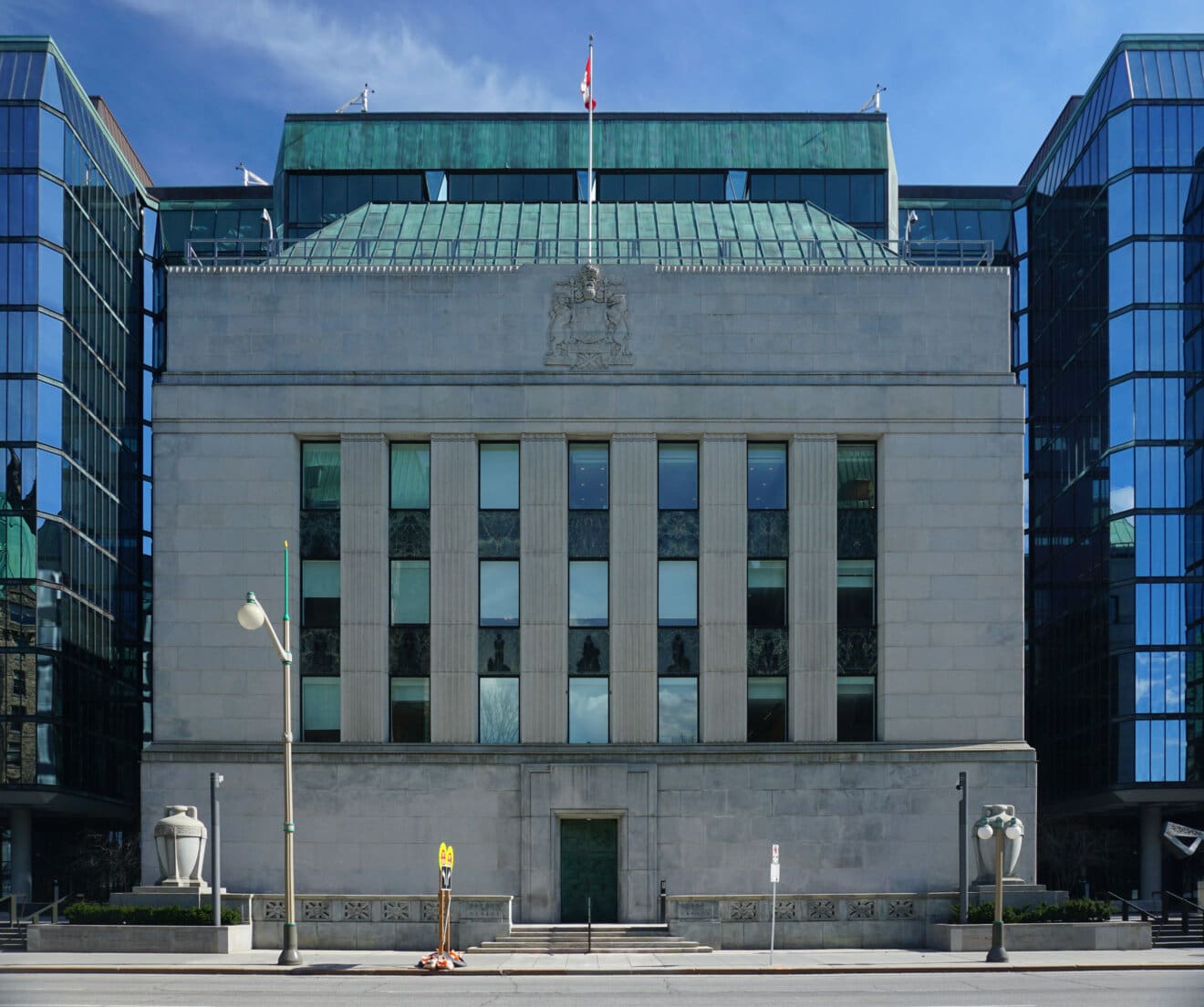
The Bank of Canada did not raise interest rates in September.
On September 2, the central bank kept its policy rate unchanged at:
2.25%
Yet Canadians shopping for a mortgage may have noticed something that seems contradictory:
Fixed mortgage rates have been moving higher.
As of late September, Ratehub listed a lowest five-year fixed market rate around 4.34%, compared with a five-year variable rate around 3.40%. WOWA’s September 26 comparison showed a similar pattern, with its lowest insured five-year fixed at 4.29% and five-year variable at 3.25%. Actual rates depend on the borrower, lender, down payment and mortgage type.
So how can mortgage rates rise if the Bank of Canada has not changed its rate?
The answer is that:
not all mortgage rates are controlled by the same thing.
And for GTA buyers, understanding that difference matters because a relatively small change in financing cost can change the monthly cost of buying a home.
Bank of Canada Rate and Mortgage Rates Are Not the Same Thing
When people hear:
“The Bank of Canada held rates.”
it is easy to assume:
“Mortgage rates should stay the same.”
But the Bank of Canada does not directly set the mortgage rate a bank offers you.
Its policy rate has a much more direct influence on variable-rate borrowing.
Variable mortgage rates are generally priced relative to a lender’s prime rate, and prime rates tend to move closely with changes in the Bank of Canada policy rate.
That means if the central bank raises or cuts its policy rate, variable borrowers often feel the effect relatively quickly.
Fixed mortgages work differently.
Fixed mortgage rates are much more closely influenced by the bond market.
And bond yields can move even when the Bank of Canada does nothing.
Why Do Government Bond Yields Matter?
When Canadian lenders offer a fixed mortgage, they are agreeing to lend money at a set interest rate for a specific period.
The cost of providing that money is influenced by funding markets, including Government of Canada bond yields.
For example, the five-year Government of Canada bond yield is an important reference point for five-year fixed mortgage pricing.
When bond yields rise, lenders often face pressure to increase fixed mortgage rates.
When bond yields decline, there may eventually be room for fixed rates to move lower.
That relationship is not perfectly one-to-one, because lenders also consider:
- funding costs;
- competition;
- profit margins;
- borrower risk;
- mortgage insurance;
- market conditions.
But bond yields are a major reason fixed rates can move independently of the Bank of Canada.
Recent increases in Canadian bond yields have already prompted lenders to raise a number of fixed mortgage rates. Canadian Mortgage Trends reported increases across several terms as lenders responded to higher government bond yields.
Why Have Bond Yields Been Under Pressure?
The current situation is being influenced by several forces at the same time.
The Bank of Canada itself said in September that inflation risks had increased amid high energy prices, new U.S. tariffs and Canadian countermeasures, while economic growth remained uncertain. The Bank nevertheless kept its policy rate at 2.25%.
At the same time, global bond markets have been dealing with concerns around:
- inflation;
- energy costs;
- government borrowing;
- trade uncertainty;
- U.S. interest rates;
- geopolitical risks.
Those factors can push longer-term bond yields upward even if Canada’s central bank is not currently hiking its overnight rate.
That is why today’s mortgage market can look like this:
Policy rate: unchanged
while
Fixed mortgage rates: moving higher.
Fixed and Variable Rates Have Opened Up a Noticeable Gap
Late-September mortgage comparisons also show a fairly large difference between some advertised fixed and variable rates.
Ratehub showed a five-year variable market rate around 3.40%, compared with a five-year fixed market rate around 4.34% as of September 25.
WOWA showed insured rates around 3.25% variable versus 4.29% fixed on September 26.
But this does not mean buyers should simply choose whichever rate is lower today.
A fixed mortgage generally provides payment certainty for the term.
A variable mortgage can change if prime rates change.
So the decision depends on factors such as:
- financial flexibility;
- risk tolerance;
- mortgage terms;
- prepayment options;
- expected time in the property;
- penalties;
- future rate changes.
For a homebuyer, this should be a mortgage-planning decision—not simply a comparison of two headline percentages.
A Small Rate Increase Can Still Change a Buyer’s Monthly Budget
The difference between 4.00% and 4.25% may not sound dramatic.
But on a large GTA mortgage, it adds up.
Consider a simplified example:
Mortgage: $700,000
Amortization: 25 years
At approximately 4.00%, the monthly mortgage payment would be about:
$3,682
At approximately 4.25%, it rises to roughly:
$3,778
That’s about:
$96 more every month
or more than:
$1,150 per year.
And that is only a quarter-point difference.
The calculation does not include property tax, Condo fees, insurance, utilities or other ownership costs.
For someone already buying near the top of their comfortable budget, small financing changes can matter.
Your Mortgage Approval From Two Months Ago May Not Tell the Whole Story Today
This is especially important for buyers who obtained a pre-approval earlier in the summer but have not purchased yet.
Suppose you were approved when fixed mortgage rates were lower.
If available rates have since increased, your monthly payment on the same mortgage can be higher.
Depending on your situation, this could affect:
- comfortable purchase price;
- qualification;
- stress-test calculations;
- preferred property type;
- how much cash you want to put down.
It does not necessarily mean your original approval is suddenly invalid.
But it is worth checking with your mortgage professional before submitting an offer based on an older budget.
For a serious buyer, the relevant question is:
“What does my financing look like today?”
not:
“What was I approved for three months ago?”
Lower Home Prices Can Be Offset by Higher Financing Costs
This is particularly relevant in the current GTA market.
Home prices in some segments have softened from previous highs, giving buyers more negotiating power.
That should improve affordability.
But financing works in the opposite direction when mortgage rates rise.
Ratehub’s August affordability analysis found affordability had improved in most of the major Canadian markets it tracked, largely because of lower home prices, while noting that rising fixed mortgage rates could erode some of those gains.
This helps explain why buyers sometimes say:
“The house is $50,000 cheaper than last year, but the monthly payment still doesn’t feel cheap.”
Both things can be true.
The purchase price may fall.
But if borrowing costs increase, part of the savings disappears.
This Is Why Buyers Should Compare Monthly Cost, Not Just Purchase Price
Imagine two homes.
Property A
Purchase price: $800,000
Property B
Purchase price: $850,000
At first glance, Property A is clearly cheaper.
But then suppose Property A has:
- $700 monthly Condo fee;
- higher property tax;
- rented parking.
Property B has:
- no Condo fee;
- lower recurring expenses.
Then add different mortgage rates, down payments and financing structures.
The answer becomes less obvious.
That is why today’s GTA buyer should increasingly compare:
Total Monthly Housing Cost
rather than simply:
Listing Price.
That total can include:
mortgage + property tax + Condo fee + insurance + utilities + expected maintenance.
A home that costs less to purchase is not always the home that costs less to own.
Does This Mean Buyers Should Choose Variable Instead?
Not necessarily.
The current advertised variable rates may look attractive compared with some fixed rates.
But that is not a prediction of which option will ultimately cost less.
If the Bank of Canada later raises its policy rate, variable borrowing costs can increase.
If economic conditions weaken and rates eventually fall, variable borrowers may benefit.
Fixed borrowers, meanwhile, generally know their contractual rate for the term but may pay a higher rate upfront for that certainty.
The Bank of Canada has said the inflation outlook remains uncertain and that it is prepared to adjust monetary policy as needed. Its next scheduled rate announcement is October 28, 2026.
Nobody buying a home should base a major real estate decision solely on guessing the Bank’s next move.
The mortgage product should fit the household’s finances and risk tolerance.
What Does This Mean for First-Time Buyers?
For first-time buyers, this market can feel particularly confusing.
Home prices in some areas are lower.
There may be fewer bidding wars.
Sellers may negotiate.
Yet mortgage rates may not be moving in the same direction.
That makes budgeting more important than ever.
For example, instead of starting with:
“I want to buy around $900,000.”
start with:
“What monthly housing cost am I comfortable carrying?”
Then work backward.
Once you include:
- mortgage;
- land transfer tax and closing cash;
- property tax;
- Condo fee if applicable;
- insurance;
- maintenance;
you may discover that your comfortable search range is different from your maximum mortgage approval.
That isn’t necessarily bad news.
It can help prevent you from becoming house-rich and cash-poor immediately after closing.
What Does This Mean for GTA Sellers?
Mortgage rates matter to sellers too.
If borrowing costs rise, a buyer who was previously comfortable shopping at $1 million may begin looking closer to $900,000 or $950,000.
That changes the pool of potential buyers for a property.
This is another reason sellers should not price their homes entirely based on:
“What my neighbourhood sold for last year.”
Today’s buyer is purchasing with:
today’s financing costs.
If the cost of borrowing changes, buyer behaviour can change even if the property itself has not.
Accurate pricing therefore becomes especially important in a market where affordability remains sensitive to interest rates.
What About Pre-Construction Buyers?
Pre-construction buyers should pay attention for a different reason.
If you purchase a project today but close several years from now, the mortgage environment at closing could look very different.
Nobody can know exactly where rates will be then.
That means a pre-con buyer should avoid building the entire purchase plan around an assumption such as:
“Mortgage rates will definitely be much lower by closing.”
Maybe they will be.
Maybe they won’t.
A stronger approach is to ask:
Could I still comfortably close if financing costs are higher than I hope?
This is especially important for buyers putting down deposits over several years.
The purchase price is fixed earlier.
The final financing rate usually is not.
Rate Holds Can Matter in a Volatile Market
For buyers who expect to purchase soon, a mortgage rate hold may also be worth discussing with a mortgage professional.
Depending on the lender and product, a rate hold can protect an offered rate for a certain period while the buyer searches for a property.
The exact rules and length vary.
That does not mean buyers should rush into a purchase simply because rates might rise.
But it can reduce one source of uncertainty while shopping.
If rates later improve, borrowers may also have options depending on their lender and mortgage arrangement.
Again, that discussion belongs with a qualified mortgage professional.
JDL Realty Perspective
The biggest takeaway from the recent mortgage-rate movement is simple:
The Bank of Canada rate is not the entire mortgage market.
The central bank held its policy rate at 2.25%.
Yet fixed mortgage rates still moved higher because fixed-rate financing responds to a different set of market forces, particularly bond yields.
For GTA buyers, that means you should not make a purchase decision based only on headlines such as:
“Bank of Canada holds rates.”
Instead, look at:
- your actual mortgage quote
- your comfortable monthly payment
- your down payment
- the property’s ongoing costs
- what your budget buys in different GTA communities
A buyer with an $850,000 budget may have very different options in:
- Toronto,
- Markham,
- Richmond Hill,
- Vaughan,
- Mississauga,
- or other GTA markets
Sometimes the better decision is not waiting for a rate change.
It may simply be changing the property type or neighbourhood being considered.
At JDL Realty, we help buyers compare current resale homes, new developments, neighbourhoods and housing types based on their actual budget—not just a headline mortgage rate.
Frequently Asked Questions
Why are fixed mortgage rates rising if the Bank of Canada didn’t raise rates?
Fixed mortgage rates are influenced heavily by Government of Canada bond yields and lender funding costs. Bond yields can rise even while the Bank of Canada keeps its overnight rate unchanged.
What is the Bank of Canada policy rate right now?
The Bank of Canada held its target overnight rate at 2.25% on September 2, 2026. The next scheduled decision is October 28.
Are variable mortgage rates currently lower than fixed rates?
Some late-September advertised rates show a sizeable gap. Ratehub listed approximately 3.40% for its lowest five-year variable rate versus roughly 4.34% for a five-year fixed rate, while WOWA showed 3.25% versus 4.29% for comparable insured categories. Actual rates and eligibility vary significantly by borrower and mortgage.
Does a lower variable rate mean variable is better?
No. Variable rates can change with prime rates, while fixed rates generally provide rate certainty for the mortgage term. Which structure fits depends on the borrower.
Should buyers wait for rates to fall before purchasing?
There is no way to know with certainty when or whether mortgage rates will fall. Buyers should compare current prices, financing, monthly carrying costs and personal circumstances rather than making a real estate decision solely on a rate forecast.
The Bottom Line
The Bank of Canada held its policy rate.
But fixed mortgage rates still moved.
That is not a contradiction.
It reflects the fact that fixed and variable mortgages respond to different parts of the financial market.
For GTA buyers, the lesson is not:
“Fixed is bad.”
or
“Variable is better.”
The more useful lesson is:
Don’t assume your mortgage cost is unchanged just because the Bank of Canada didn’t move.
If you received a mortgage approval several weeks or months ago, it may be worth checking your current numbers again before making an offer.
And if your financing budget has changed, your real-estate strategy can change with it.
A different neighbourhood, property type or purchase price can sometimes make a much bigger difference than trying to predict the next rate announcement.
Thinking about buying in Toronto or the GTA? Contact JDL Realty with your approximate budget, preferred area and property type, and we can help you compare what your budget buys in today’s market.

Your Industry Experts
We’re here to help. Whether you’re an agent or a client, we have the support and expertise you need to thrive in your next endeavour.