
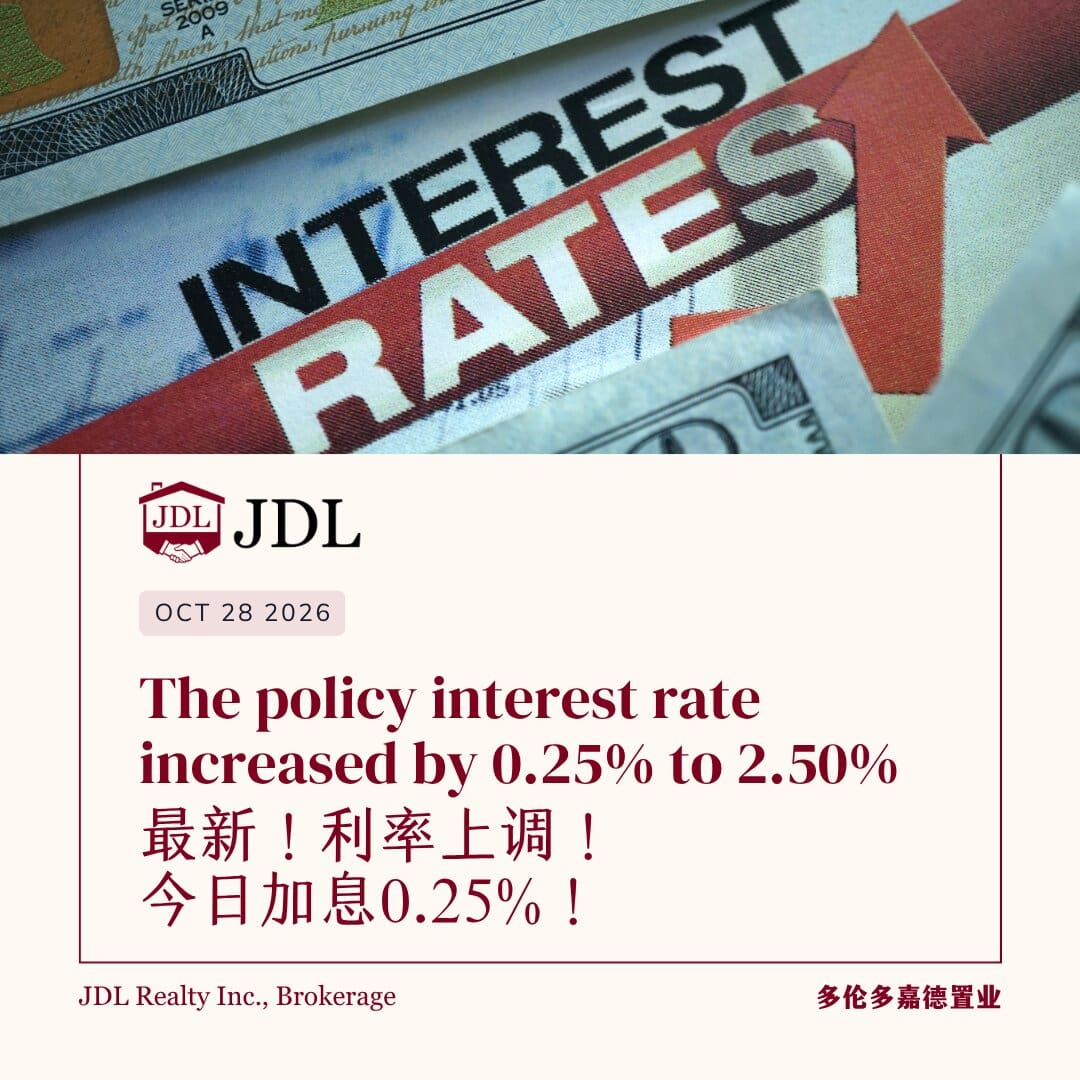
After nearly a year with the policy rate sitting at 2.25%, the Bank of Canada entered its October 28 decision with markets expecting a possible change in direction.
The widely expected move was:
+0.25 percentage points
taking the overnight policy rate from:
2.25% to 2.50%.
A Reuters survey conducted ahead of the announcement found that 19 of 34 economists expected the Bank to increase rates by 25 basis points. Market pricing had also moved strongly toward a hike in the days leading up to the decision.
Why?
Inflation had moved back above the Bank’s 2% target, reaching 3.1% in September, with higher energy prices playing a major role.
For GTA homeowners and buyers, though, the most important question is not:
“Did rates go up by 0.25%?”
It is:
“What does that actually change for me?”
Because a quarter-point policy-rate move does not affect every mortgage, every buyer or every property in the same way.
First: What Does a 0.25% Bank of Canada Increase Actually Change?
The Bank of Canada sets the target for the overnight rate.
Before the October decision, that rate was:
2.25%.
If increased by 25 basis points, it becomes:
2.50%.
This rate is not the mortgage rate you see advertised by a bank.
Instead, it influences short-term borrowing costs throughout the financial system.
One of the most direct effects is usually on:
bank prime rates.
Before the decision, major-bank prime rates were around:
4.45%.
If banks pass through the full 0.25% increase, prime would typically move toward approximately:
4.70%.
That matters especially for borrowers with:
- Variable-rate mortgages
- Adjustable-rate mortgages
- Home equity lines of credit
- Other loans tied directly to prime
But the impact on fixed-rate mortgages is different.
Variable Mortgage? You May Feel the Change Quickly
For borrowers with an adjustable-payment variable mortgage, a Bank of Canada increase can flow through relatively quickly.
Suppose your mortgage rate is based on:
Prime – 0.50%.
With prime at 4.45%, your mortgage rate might be around:
3.95%.
If prime increases to 4.70%, that becomes approximately:
4.20%.
The difference sounds small.
Only:
0.25%.
But on a large GTA mortgage balance, it still affects monthly cash flow.
For illustration, a quarter-point increase could add roughly:
- Around $65–$75/month on a $500,000 mortgage balance
- Around $80–$90/month on a $600,000 balance
- Around $105–$120/month on an $800,000 balance
Actual amounts depend on your mortgage contract, remaining amortization, payment structure and lender.
One increase alone may not dramatically change someone’s finances.
But buyers should think about the cumulative effect if rates continue moving higher.
What If Your Variable Mortgage Has a Fixed Payment?
Not every variable mortgage works the same way.
Some borrowers have a variable interest rate but a:
fixed regular payment.
If your lender does not immediately increase the payment when rates rise, more of each payment may go toward:
interest
and less toward:
principal.
That can affect your effective amortization.
Your mortgage contract determines exactly how this works.
So if you already have a variable mortgage, this is a good time to understand:
Does my payment change when prime changes, or does the interest/principal split change instead?
What About Fixed Mortgage Rates?
This is where one of the biggest misunderstandings happens.
If the Bank of Canada raises its rate by 0.25%, that does not automatically mean:
5-year fixed mortgage rates also rise by exactly 0.25%.
Fixed mortgage pricing is influenced much more directly by:
Government of Canada bond yields
along with lender funding costs, competition and risk.
Bond markets often move based on expectations before the Bank of Canada actually announces anything.
That means fixed mortgage rates may:
rise before a Bank of Canada hike;
stay relatively stable after the announcement;
or even move in another direction later.
So buyers should avoid assuming:
“Bank of Canada +0.25% = my fixed mortgage +0.25% tomorrow.”
It is not that simple.
Why Would the Bank Raise Rates When the Economy Is Still Soft?
This is what makes the October decision particularly interesting.
Canada is not dealing with a booming economy.
There are still concerns around:
- economic growth;
- employment;
- trade uncertainty;
- and housing activity.
But inflation has become a renewed concern.
September CPI reached:
3.1%.
A major driver was energy.
Higher oil and gasoline costs can directly increase inflation.
But what worries central banks more is the possibility that those costs begin spreading into:
- transportation;
- food;
- manufacturing;
- services;
- and broader inflation expectations.
The Bank had already warned in September that persistent energy prices and new tariff pressures could increase inflation risks.
So the debate became:
Should the Bank wait and see whether energy inflation fades?
or:
Should it raise rates before higher inflation becomes more widespread?
That is why this decision attracted considerably more attention than many of the rate holds earlier in 2026.
Does a 0.25% Hike Mean GTA Buyers Should Stop Looking?
No.
A change in the Bank of Canada rate should be part of your affordability calculation.
It should not automatically determine whether you buy a home.
Suppose you were planning to purchase a property for:
$750,000.
The better questions are:
- What mortgage can I comfortably carry?
- What is my monthly payment under different rate scenarios?
- How much money will I have left after housing costs?
- What happens if my mortgage rate is another 0.50% higher at renewal?
- How long do I expect to own this property?
- What properties are currently available within my comfortable budget?
A buyer should not make a major real estate decision simply because:
“rates went up today.”
But they should understand how the change affects their numbers.
Buyers: Recheck Your Pre-Approval
This may be one of the most practical things buyers can do.
If you received a mortgage pre-approval several weeks or months ago, confirm:
- Your current rate hold
- When it expires
- Whether your qualification amount has changed
- Your estimated monthly payment
- Whether you still feel comfortable with your original maximum budget
There is an important difference between:
what a lender says you qualify for
and:
what you personally feel comfortable paying every month.
If your maximum approval is $800,000, that does not necessarily mean you should buy an $800,000 property.
A rate increase is a good reminder to calculate your real monthly housing budget.
What Could the Difference Look Like on a GTA Purchase?
Imagine two buyers.
Buyer A
Mortgage required:
$500,000
A quarter-point change may increase the monthly payment by roughly $70, depending on the mortgage.
Buyer B
Mortgage required:
$900,000
The same interest-rate move has a much larger dollar impact.
This is why interest-rate headlines often feel very different depending on where someone is buying.
A 0.25% move may have a relatively modest effect on a buyer purchasing a smaller condo with a large down payment.
For someone financing a high-priced detached home with a large mortgage:
the same rate change matters considerably more.
Does This Mean GTA Home Prices Will Fall?
Not automatically.
Interest rates are important to housing demand.
But they are not the only factor affecting home prices.
The GTA market is currently being shaped by:
- Mortgage affordability
- Buyer confidence
- Employment
- Inventory
- Seller motivation
- Population growth
- New construction
- Property type
- Neighbourhood
- Broader economic uncertainty
And different parts of the GTA are already behaving differently.
For example:
the condo market has substantial inventory and softer pricing pressure;
while certain low-rise and well-priced resale properties can still attract strong interest.
So it would be too simplistic to say:
“Rates increased, therefore GTA home prices will drop.”
The more useful question is:
How will the rate change affect demand in the specific segment where you are buying or selling?
Sellers: Will a Rate Increase Reduce Buyer Demand?
Potentially.
Higher borrowing costs can reduce purchasing power for some buyers.
A buyer who previously felt comfortable around:
$900,000
may decide they now want to stay closer to:
$850,000 or $875,000.
Others may postpone their purchase.
But again, sellers should not assume:
“Rates increased, so nobody will buy.”
There are still active buyers in the market.
The difference is that those buyers may become:
more price-sensitive;
more selective;
less willing to overlook problems;
and more careful about monthly costs.
That makes correct pricing even more important.
In a Rate-Sensitive Market, Overpricing Becomes More Expensive
Imagine two comparable homes.
One is reasonably priced based on recent sales.
The other is listed:
$100,000 higher
because the seller wants to “try the market.”
When borrowing costs are low and buyers are competing aggressively, overpricing can sometimes be corrected by strong demand.
In a more cautious market, buyers have more time to compare.
They ask:
- Why is this property more expensive?
- What did the neighbour sell for?
- How much will my mortgage payment be?
- What else can I buy for the same monthly cost?
If the answer is unclear, they move on.
That is why sellers need to understand:
today’s buyer is not just shopping by purchase price.
They are shopping by:
monthly affordability.
A Buyer May Compare Homes Differently After a Rate Increase
Suppose a buyer has two choices.
Property A
Price:
$850,000
Needs renovations.
Property B
Price:
$900,000
Move-in ready.
When rates are changing, the buyer may think differently about that extra $50,000.
Not only:
“Is the house worth $50K more?”
but:
“How much does that extra $50K cost me every month?”
That can affect demand for:
renovated versus unrenovated homes;
condos with high maintenance fees;
properties with secondary income potential;
and homes requiring large mortgages.
Condo Buyers Should Look at More Than the Mortgage Rate
For condo buyers in particular, monthly affordability includes:
- Mortgage payment
- Maintenance fee
- Property tax
- Insurance
- Utilities
- Parking if applicable
A condo may have a lower purchase price but a high maintenance fee.
Another may cost $50,000 more but carry a significantly lower monthly condo fee.
When borrowing costs rise, those monthly differences become even more important.
That is why we recently emphasized that:
the cheapest condo is not necessarily the cheapest property to own.
What About Buyers Waiting for Rates to Fall Again?
This is one of the hardest questions in real estate.
Some buyers have been waiting because they expected:
rates to keep falling.
But the October rate debate is an important reminder:
- interest rates do not move in only one direction.
- Economic conditions change.
- Inflation changes.
- Oil prices change.
- Trade conditions change.
- Central-bank expectations change.
A few months ago, many forecasters expected the Bank of Canada to remain on hold for an extended period.
By late October, market expectations had shifted strongly toward a rate increase.
So trying to perfectly time:
the lowest mortgage rate
and:
the lowest home price
at exactly the same moment is extremely difficult.
A more practical strategy is to ask:
Can I comfortably afford the property under today’s numbers?
If yes, then evaluate the property itself.
Should Buyers Rush Before Rates Rise Further?
Also no.
The opposite mistake is:
“Rates are going up — buy immediately before they get worse.”
That can create unnecessary pressure.
There is no guarantee of a particular future interest-rate path.
Economists were expecting another possible increase by early 2027, but forecasts can change quickly as new inflation, employment and economic-growth data arrive.
A buyer should not rush into:
- the wrong property;
- the wrong neighbourhood;
- or an uncomfortable mortgage
because of a prediction about the next Bank of Canada meeting.
What Should GTA Buyers Do Now?
Instead of reacting emotionally to one announcement, consider five practical steps.
1. Update your mortgage numbers
Ask your lender or mortgage professional to recalculate your payment and qualification.
2. Set a comfortable budget, not just a maximum approval
Leave room for:
maintenance;
- property tax;
- utilities;
- repairs;
- and normal life expenses.
3. Compare recent sales
The asking price is not necessarily the market value.
4. Look at total monthly ownership cost
Especially for condos.
5. Take advantage of choice
If the market gives you multiple options, use that time to compare carefully rather than rushing.
What Should GTA Sellers Do Now?
For sellers, the priorities are slightly different.
Price from today’s market
Not from:
Not from your neighbour’s peak sale.
And not from what you “need” to receive.
Understand your competition
If five similar homes are available, buyers will compare all of them.
Make the property easy to choose
Condition, presentation, photos and marketing matter more when buyers are cautious.
Watch early market feedback
If buyers consistently reject the property at the current price, waiting alone may not solve the problem.
The Bigger Question: Is This the Beginning of Another Rate-Hike Cycle?
One quarter-point increase by itself is manageable for many borrowers.
The bigger issue is:
what comes next?
Ahead of the October decision, a Reuters poll found that a majority of economists expected one additional increase by the end of March 2027.
But that is a forecast — not a guarantee.
The next direction will depend heavily on:
- inflation;
- energy prices;
- economic growth;
- employment;
- consumer spending;
- and global trade conditions.
That is why buyers and sellers should avoid building a real estate plan around a single forecast.
Instead:
stress-test your own plan under more than one interest-rate scenario.
Buying or Selling in the GTA After the Rate Decision?
If today’s rate announcement has made you reconsider your plans, start with the numbers rather than the headline.
For buyers:
tell us your:
budget + preferred area + property type
and JDL Realty can help you compare what is currently available and how different price points may affect your search.
For sellers:
we can review:
- recent comparable sales;
- current competition;
- market activity;
- and how buyers are responding in your specific neighbourhood.
Because a 0.25% rate change matters.
But what matters more is:
what that 0.25% actually means for your specific real estate decision.
Source: Bank of Canada

Your Industry Experts
We’re here to help. Whether you’re an agent or a client, we have the support and expertise you need to thrive in your next endeavour.