
Toronto homeowners have another annual deadline to remember.
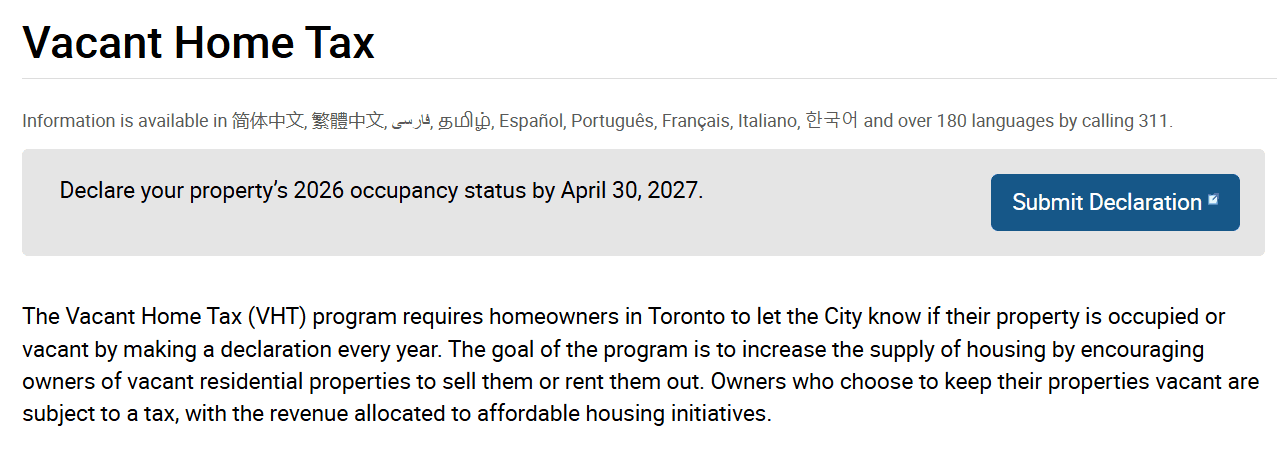
The City of Toronto officially opened the 2026 Vacant Home Tax declaration period on November 2, 2026.
The deadline is:
April 30, 2027
And one of the biggest misunderstandings about the program is still this:
You need to submit a declaration even if you live in the property yourself.
All Toronto residential property owners are generally required to report the property’s occupancy status for the 2026 calendar year. Owners who fail to declare may have the property deemed vacant and the Vacant Home Tax applied.
For 2026, the Vacant Home Tax rate is:
3% of the property’s Current Value Assessment
as determined by MPAC.
For example:
- CVA $600,000 → $18,000 VHT
- CVA $800,000 → $24,000 VHT
- CVA $1,000,000 → $30,000 VHT
So even if your home is occupied, forgetting the declaration can become a very expensive administrative problem.
Who Needs to Declare?
Toronto residential property owners generally need to submit a declaration every year.
That includes properties that were:
- The owner’s principal residence
- Occupied by a tenant
- Occupied by another permitted occupant
- Vacant but eligible for an exemption
- Vacant
The 2026 declaration covers:
January 1 to December 31, 2026.
Even if you lived in the property throughout the year:
you still need to declare.
When Is a Property Considered Vacant?
Under the City’s current rules, a residential property may generally be considered vacant if it was unoccupied for:
six months or more during the taxation year,
unless it qualifies as a principal residence, is occupied by a permitted occupant, or qualifies for an exemption.
For example, a rental property can generally be considered occupied if a tenant occupies it under a written agreement of at least 30 days and the total occupancy reaches at least six months during the year.
This is why landlords should keep clear tenancy and occupancy records.
What If You Travel for Several Months?
Being away from Toronto does not automatically make your home vacant.
The City specifically recognizes situations such as:
snowbirds;
extended travel;
or temporary work outside the city.
If the property remains your principal residence and meets the City’s requirements, it may still be declared occupied even if you are away for an extended period.
So the question is not simply:
“Was I physically inside the house for six months?”
The property’s actual occupancy status and principal-residence status matter.
What Exemptions May Apply?
Some properties can remain vacant for six months or more and still qualify for an exemption.
Examples currently listed by the City include:
- Death of a registered owner
- Principal resident in hospital, long-term care or supportive care
- Major repairs or renovations that prevent normal occupancy
- Certain court orders
- Transfer of legal ownership
- Certain employment-related situations
- Certain newly constructed inventory
- Certain medical-related secondary residence situations
Supporting documentation may be required.
The important point is:
having a reason for the property being empty does not automatically mean it qualifies for an exemption.
The situation still needs to fit the City’s criteria.
How Do You Submit the 2026 Declaration?
Owners can submit the declaration:
Online
Through the City of Toronto VHT portal.
By phone
Through 311.
In person
At Toronto City Hall or a civic centre Tax and Utility Payment Counter.
You will generally need:
your customer number
and
your property address or 21-digit assessment roll number.
These can be found on your property tax bill or related City tax documents.
If you submit online, save the confirmation number.
That record can become especially useful if you later sell the property.
Buying or Selling a Toronto Property? This Is Where VHT Matters More
For a normal homeowner, the Vacant Home Tax may feel like an annual administrative requirement.
But once a property is being bought or sold, it becomes part of:
closing due diligence.
The City states that both purchasers and vendors are responsible for making appropriate arrangements to ensure the relevant declaration has been submitted. Sellers should provide buyers with a copy of the completed declaration.
This is especially important because unpaid Vacant Home Tax can be attached to the property.
Scenario 1: The Property Is Sold During 2026
Suppose the declaration is for:
2026
and the property also changes ownership during:
2026.
In this situation, either the buyer or seller may submit the declaration, and the property can qualify for the Transfer of Legal Ownership exemption if the applicable requirements are met.
This should still be handled carefully as part of the closing process.
Do not simply assume:
“The other side will deal with it.”
Scenario 2: The Property Is Sold in 2027, but the Declaration Is for 2026
This is different.
If the property is sold in:
2027
but the declaration concerns:
2026 occupancy,
the City says the seller must submit the declaration, because the seller owned the property during the year being declared and knows how it was used.
So if you are buying a Toronto property in 2027:
ask whether the seller completed the 2026 VHT declaration.
Buyers: Ask for Proof Before Closing
This may be the most important real estate takeaway.
If no declaration is received, the City says:
- The property can be deemed vacant
- The Vacant Home Tax can be charged
- The new owner can become responsible for charges associated with the property
That means buyers should not simply assume:
“The seller probably filed it.”
Ask for documentation.
And have your lawyer review property-tax liabilities as part of closing.
A missing declaration can turn into a problem after ownership changes.
Sellers: Don’t Leave This Until the Last Minute
If you are preparing to sell a Toronto property, check:
Have all required VHT declarations been completed?
Keep records such as:
- Declaration confirmation
- Occupancy records
- Lease agreements if applicable
- Supporting exemption documents
The City says owners should retain records supporting occupancy or exemption claims for at least:
three years.
Taking care of this before listing or closing can make the transaction much smoother.
Power of Sale Buyers Should Pay Particular Attention
This is another important point for buyers.
A Power of Sale purchase does not automatically create a Vacant Home Tax exemption.
The City says the VHT attaches to the property, and Power of Sale buyers purchase the property “as is,” including responsibility for associated tax liabilities.
So if you are considering a Power of Sale property in Toronto:
VHT status should be part of your due diligence.
A lower purchase price does not automatically mean there are no outstanding property-tax issues.
What Happens If You Miss the April 30 Deadline?
If a required declaration is not submitted by:
April 30, 2027
the City may assume the property was vacant and issue a Vacant Home Tax bill.
Owners can dispute certain VHT bills through the City’s Notice of Complaint process.
But it is much easier to:
submit the declaration correctly and on time
than to resolve a tax bill afterward.
A Quick VHT Checklist for Toronto Owners
Before April 30, 2027:
- ✓ Declare your property’s 2026 occupancy status
- ✓ Declare even if it is your principal residence
- ✓ Keep your confirmation number
- ✓ Keep supporting records if claiming an exemption
If selling:
- ✓ Make sure the declaration has been filed
- ✓ Provide relevant documentation to the buyer
If buying:
- ✓ Ask about the property’s VHT status
- ✓ Ask for proof of declaration
- ✓ Have your lawyer review any outstanding property-tax liabilities
JDL Realty Perspective
For most homeowners, filing the Vacant Home Tax declaration is relatively simple.
The bigger risk is:
forgetting about it.
For Toronto homeowners:
file every year, even if you live in the property.
For landlords:
keep clear occupancy records.
For sellers:
make sure outstanding declarations are handled before closing.
For buyers:
do not treat VHT as “the seller’s problem” without checking.
The Vacant Home Tax may begin as a City tax requirement.
But during a real estate transaction:
it becomes part of your due diligence.
Buying or Selling a Toronto Property?
If you are planning to buy or sell in Toronto, the purchase price is only one part of the transaction.
Buyers should also understand:
- property taxes;
- condo fees;
- closing costs;
- VHT status;
- and other property-specific obligations.
Sellers should make sure the property is properly prepared not only for marketing, but also for closing.
JDL Realty can help you understand the real estate side of the transaction and coordinate with the appropriate legal, mortgage and tax professionals when needed.
Source: City of Toronto
Your Industry Experts
We’re here to help. Whether you’re an agent or a client, we have the support and expertise you need to thrive in your next endeavour.