


Beginning January 1, 2027, eligible purchasers will have a statutory 10-day cooling-off period during which they can rescind their purchase agreement without penalty.
The change has been several years in the making.
Ontario first formally announced the legislation in May 2024. The Homeowner Protection Act, 2024 received Royal Assent the following month. An implementation date of January 1, 2026 was later set, only to be postponed by one year.
Now, in August 2026, the province has finalized the regulations and required forms necessary to put the new system into effect.
For GTA buyers considering a new detached home, semi-detached home, freehold townhouse or another qualifying new freehold property, the change could provide valuable time to review one of the largest contracts they may ever sign.
What Is Ontario’s New 10-Day Cooling-Off Period?
Starting January 1, 2027, qualifying purchasers of new freehold homes will be able to rescind their purchase agreement within the statutory cooling-off period.
Under section 53.2 of the New Home Construction Licensing Act, 2017, written notice of rescission must be received by the vendor within 10 days after the latest of three events:
- The purchaser receives the required information.
- The prescribed requirements relating to that information have been satisfied.
- The purchaser receives a copy of the purchase agreement executed by both the vendor and purchaser.
The final regulation specifies that the required information includes the applicable New Freehold Home Addendum and the new Information for Buyers of New Freehold Homes sheet. Those documents must also be signed by both the vendor and purchaser.
Tarion summarizes the process this way: the information sheet and addendum must be completed and included with the purchase agreement delivered to the buyer before the agreement becomes binding on the purchaser and before the cooling-off period begins.
Can the Buyer Cancel for Any Reason?
Yes.
The purpose of the cooling-off period is to allow an eligible buyer time to reconsider the transaction and review the agreement before becoming fully committed.
Ontario’s 2024 Fall Economic Statement specifically described the new protection as allowing buyers to cancel during the 10-day period at any time and for any reason without financial penalty.
If the purchaser properly rescinds under the legislation, the vendor must promptly return all money received under the purchase agreement and credited toward the purchase price, without penalty or charge, together with interest calculated at the prescribed rate.
That can be particularly important for pre-construction buyers who may have already submitted a substantial initial deposit.
When Was the Cooling-Off Period First Announced?
The formal legislative announcement came on May 27, 2024.
On that date, the Ontario government introduced the Homeowner Protection Act, 2024, saying the legislation would provide additional protection to purchasers of new freehold homes by establishing a 10-day cooling-off period.
The idea itself had been under discussion even earlier.
In March 2023, Ontario announced that it was consulting on whether to introduce a cooling-off period for buyers of new freehold homes and whether purchasers should be required to obtain legal advice before signing new-home purchase agreements.
So the timeline did not begin overnight.
The province first explored the policy through consultation, then introduced legislation in 2024.
June 2024: The Homeowner Protection Act Receives Royal Assent
The Homeowner Protection Act, 2024 received Royal Assent on June 6, 2024.
However, this did not mean that the new freehold cooling-off period immediately became available to buyers.
The relevant amendments to the New Home Construction Licensing Act were written to come into force on a later date set by the province.
That distinction is important.
A buyer who signed a qualifying new freehold purchase agreement in 2024, 2025 or 2026 did not automatically receive this new statutory 10-day rescission right merely because the legislation had passed.
The effective date had yet to be set and the supporting regulations still had to be completed.
Ontario Continued Consulting on the Details
After the legislation passed, the government continued developing the rules needed to make the new system work.
Ontario’s consultation materials explained that new-home purchase agreements can contain complicated provisions dealing with matters such as builder termination rights, price changes and project risks.
The consultation suggested that a cooling-off period would give buyers additional time after signing to understand those risks, seek advice, negotiate where possible or decide whether to proceed.
This matters because a builder’s Agreement of Purchase and Sale can be very different from a typical resale agreement.
New-home contracts may contain:
- Builder-specific schedules
- Development and closing adjustments
- Tentative closing provisions
- Early termination conditions
- Upgrade provisions
- Assignment restrictions
- Construction-related clauses
- Other project-specific obligations
A cooling-off period does not eliminate those issues.
It gives buyers more time to understand them.
July 2025: January 1, 2026 Was Set as the Original Start Date
On July 31, 2025, Ontario issued Order in Council 1023/2025.
That order named:
January 1, 2026
as the date on which the relevant provisions of the Homeowner Protection Act would come into force.
At that point, buyers and industry professionals reasonably expected the new cooling-off framework to begin at the start of 2026.
But several months later, the timeline changed.
November 2025: Ontario Delays the Rule by One Year
On November 27, 2025, Ontario issued Order in Council 1495/2025.
The new order amended the previous commencement date by replacing:
January 1, 2026
with:
January 1, 2027.
This officially postponed implementation by one year.
Importantly, the Order in Council itself does not provide a detailed explanation for the delay.
That means it would be inaccurate to state that the legislation was postponed for one specific reason based solely on the official order.
Why Was the Cooling-Off Period Pushed Back?
The official commencement order confirms the delay, but does not spell out the government’s reasoning.
Industry reporting provides additional context.
The Durham Region Home Builders’ Association, reporting an Ontario Home Builders’ Association update, said the change followed a review of current market conditions by the Ministry of Public and Business Service Delivery and Procurement.
The industry group also said builders had raised concerns about how a mandatory cooling-off period could affect builder agreements, project timelines and market stability, particularly during difficult new-home market conditions.
So the most accurate way to describe the delay is:
Ontario formally postponed implementation from January 1, 2026 to January 1, 2027. The government’s legal order did not state a detailed reason, while home-building industry sources said the change followed a review of market conditions after concerns had been raised about implementation.
That distinction is important.
August 2026: The Final Rules Are Now in Place
The regulatory framework was finally completed in August 2026.
Ontario Regulation 290/26, specifically governing the cooling-off period, was:
- Made: August 26, 2026
- Filed: August 27, 2026
- Published on e-Laws: August 27, 2026
The regulation is currently marked as not yet in force and will take effect on January 1, 2027.
Ontario also finalized O. Reg. 289/26, which sets out the new information-sheet and addendum requirements for purchase agreements entered into on or after January 1, 2027.
The required HCRA forms themselves are dated August 24, 2026.
HCRA confirms that they must be used for applicable agreements entered into on or after January 1, 2027.
So after more than two years between the initial 2024 legislation and implementation, buyers now have a finalized framework and a firm effective date.
Ontario’s New Freehold Cooling-Off Period: Timeline
| Date | What Happened |
|---|---|
| March 31, 2023 | Ontario announces consultation on a possible cooling-off period for new freehold homes |
| May 27, 2024 | Homeowner Protection Act, 2024 introduced, including the proposed 10-day protection |
| June 6, 2024 | Legislation receives Royal Assent |
| 2024 | Province continues consultation on implementation |
| July 31, 2025 | Ontario sets January 1, 2026 as the original effective date |
| November 27, 2025 | Effective date postponed to January 1, 2027 |
| August 24, 2026 | New HCRA information sheets and addenda dated |
| August 26–27, 2026 | Final cooling-off and purchase-agreement regulations made and filed |
| January 1, 2027 | New rules take effect |
Which Homes Will Qualify?
This is where buyers need to be careful.
The new rule does not apply to every home transaction in Ontario.
The legislation defines a new freehold home by reference to certain categories under the Ontario New Home Warranties Plan Act. Those categories generally include self-contained one-family dwellings that may be detached or attached, as well as certain buildings containing up to two self-contained one-family dwellings under one ownership.
In practical terms, this can include many newly built:
- Detached homes
- Semi-detached homes
- Freehold townhomes
- Other qualifying low-rise new homes
But the legal structure matters.
Which Transactions Are Excluded?
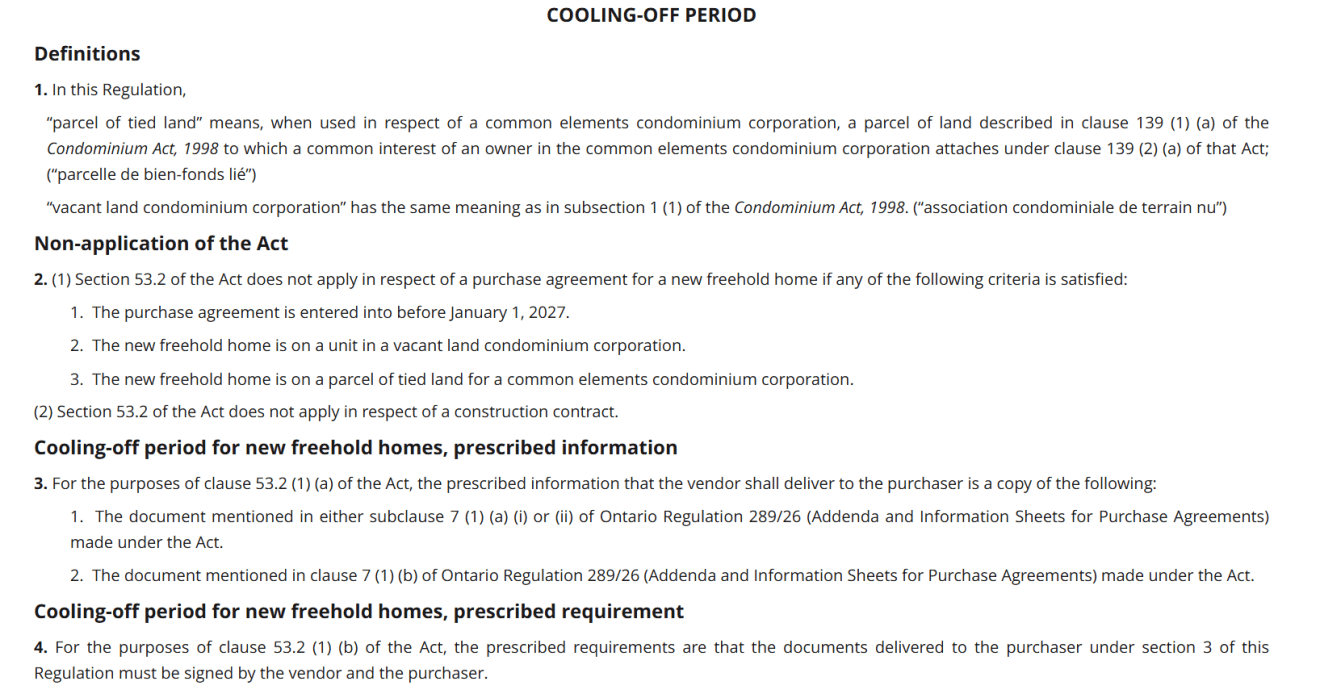
The final cooling-off regulation expressly says section 53.2 does not apply where:
- The purchase agreement was entered into before January 1, 2027
- The new freehold home is on a unit in a vacant land condominium corporation
- The new freehold home is on a parcel of tied land connected to a common elements condominium corporation
- The agreement is a construction contract, rather than the applicable purchase agreement for a new freehold home.
This is particularly relevant in the GTA because some properties marketed as “townhomes” or “freehold-style” homes can have condominium or POTL structures.
The marketing description alone does not determine whether the statutory cooling-off provision applies.
The legal structure of the property and the purchase agreement matter.
Does the New Rule Apply to Resale Homes?
No.
This new statutory cooling-off period is aimed at qualifying new freehold home purchases, not a normal resale transaction between an existing homeowner and a buyer.
If you are purchasing a resale detached house, townhouse or other existing property, you should not assume you automatically receive 10 days after signing to change your mind.
Conditions such as:
- Financing
- Home inspection
- Status certificate review
- Lawyer review
depend on the specific offer and transaction.
That makes the distinction between new construction and resale especially important.
What About New Condominiums?
New condominium purchasers in Ontario already have a statutory rescission regime under the Condominium Act, 1998.
Under the existing condo framework, a purchaser generally has a 10-day rescission period tied to receiving the required disclosure information and executed Agreement of Purchase and Sale.
The new freehold framework is therefore intended to extend a comparable form of consumer protection to a category of buyers who historically did not have the same broad statutory right.
However, the two regimes are established under different legislation and have different document requirements.
Buyers should not assume the rules are identical in every respect.
When Does the 10-Day Period Actually Begin?
This is one of the most important details in the new legislation.
The 10 days do not necessarily begin simply when the buyer signs something at a sales office.
Under the legislation, the written rescission notice must reach the vendor within 10 days after the latest of:
- Receiving the prescribed information
- Completion of the prescribed requirements
- Receiving the purchase agreement executed by both parties.
Under the final regulation, the prescribed documents include:
New Freehold Home Addendum
Either the:
- Firm Closing Date version, or
- Tentative Closing Date version
and:
Information for Buyers of New Freehold Homes
The required documents must be signed by both purchaser and vendor.
This is why buyers should pay close attention to when they actually receive the fully completed documentation.
What Happens to the Buyer’s Deposit if They Cancel?
If an eligible purchaser properly exercises the statutory right of rescission, the legislation requires the vendor to promptly refund the purchaser without penalty or charge.
That includes money received under the purchase agreement and credited toward the purchase price, together with interest calculated at the prescribed rate.
Ontario has also created an administrative-penalty framework related to the new requirements.
Under the regulation coming into force with the new rules, a vendor’s failure to promptly provide the required refund can attract a maximum base administrative penalty of $50,000.
What Should Buyers Do During Those 10 Days?
The cooling-off period should not simply be viewed as 10 extra days to decide whether you “like the house.”
For new construction buyers, those days can be extremely valuable.
Have a Lawyer Review the Purchase Agreement
Builder agreements can contain clauses that are significantly different from standard resale contracts.
A real estate lawyer can help identify obligations, restrictions and potential costs.
Review Closing Costs and Adjustments
The purchase price shown on a builder’s price list may not represent the buyer’s final cost.
Review possible:
- Development-charge adjustments
- Utility connection charges
- Legal costs
- Tarion-related costs
- Meter installation charges
- Levies
- Other builder adjustments
Confirm Your Financing
A mortgage pre-approval does not always guarantee that financing will remain available on exactly the same terms when a pre-construction property eventually closes.
Buyers should discuss the transaction with their lender or mortgage professional.
Review the Closing Timeline
Understand whether the agreement includes a:
- Firm Closing Date
- Tentative Closing Date
and what rights the builder has if construction is delayed.
Check Assignment Rules
If your circumstances change before closing, can you assign the agreement?
If so:
- Is builder consent required?
- Is there an assignment fee?
- Are there restrictions?
Understand the Property Structure
Especially with townhome developments, confirm whether you are buying:
- Standard freehold
- POTL
- Vacant land condominium
- Traditional condominium
because the legal structure can affect both your obligations and which statutory protections apply.
Why Does This Matter for GTA Pre-Construction Buyers?
The change is particularly relevant across markets such as:
Toronto, Markham, Richmond Hill, Vaughan, Aurora, Newmarket, Mississauga, Brampton, Oakville and other GTA communities where low-rise new-home developments remain an important part of the housing market.
Buying directly from a builder can feel straightforward at a sales centre.
You select:
- A lot
- A model
- An elevation
- A price
and then sign.
But the actual Agreement of Purchase and Sale may be dozens of pages long and contain important details that are not obvious from the marketing materials.
The new cooling-off period gives eligible purchasers a defined opportunity to move from:
“I want this home.”
to:
“I understand the agreement I’m signing.”
That is a meaningful difference.
Does a 10-Day Cooling-Off Period Mean Buyers Don’t Need a Realtor or Lawyer?
No.
The new protection gives buyers more time.
It does not replace professional advice.
A cooling-off period cannot tell you:
- Whether the property’s asking price makes sense
- Which builder incentives are valuable
- How the neighbourhood compares
- Whether the floor plan will be easy to resell
- What competing projects are offering
- Whether the deposit structure suits your finances
- Whether a contract clause creates legal risk
- Whether the closing adjustments are reasonable for your circumstances
The 10 days are most useful when buyers actually use them to conduct proper due diligence.
JDL Realty’s Perspective
Ontario’s new freehold cooling-off period is an important change for new-home buyers.
But the most interesting part of the story is how long it took to reach implementation.
The province began exploring the idea in 2023.
The legislation was formally introduced in May 2024 and received Royal Assent in June.
An original January 2026 start date was established in 2025, then postponed by one year.
Now, with the final regulations filed in August 2026, buyers and builders finally have clarity:
January 1, 2027 is the effective date.
For buyers, the new protection creates valuable time to review the purchase agreement and understand the financial and legal commitments involved.
But it should not be treated as a substitute for careful preparation.
At JDL Realty, we believe buyers should understand the entire purchase—not just the advertised price.
That means looking at:
Location
Builder
Floor plan
Price
Deposit structure
Closing costs
Legal structure
Market conditions
and:
Long-term resale potential
before making a commitment.
Frequently Asked Questions
When does Ontario’s 10-day freehold cooling-off period start?
It takes effect January 1, 2027 for applicable purchase agreements entered into on or after that date.
Wasn’t it supposed to start in 2026?
Yes.
Ontario originally set January 1, 2026 as the commencement date in July 2025. In November 2025, the province formally amended the date to January 1, 2027.
Why did Ontario delay the rule?
The government’s Order in Council formally changed the date but did not provide a detailed explanation. Ontario home-building industry sources said the postponement followed a ministry review of current market conditions, while builders had raised concerns about implementation and its potential impact on projects and market stability.
When were the final regulations released?
The main cooling-off regulation, O. Reg. 290/26, was made on August 26, 2026 and filed on August 27, 2026. The new HCRA forms are dated August 24, 2026.
Can a buyer cancel without giving a reason?
The province describes the new statutory period as allowing qualifying buyers to cancel for any reason during the cooling-off period without financial penalty.
Does it apply to resale houses?
No. The new statutory protection concerns qualifying new freehold homes, not ordinary resale transactions.
Does it apply to every new townhouse?
Not necessarily.
The legal ownership structure matters. The regulation excludes new freehold homes located on vacant-land condominium units and parcels of tied land associated with common-elements condominium corporations from this specific section 53.2 cooling-off regime.
The Bottom Line
After years of consultation, legislation, an original implementation date and a one-year postponement, Ontario’s new freehold cooling-off framework is finally set.
Starting January 1, 2027:
Eligible buyers of qualifying new freehold homes will receive a 10-day statutory period to reconsider their purchase agreement.
For buyers, that means more time to:
Review.
Ask questions.
Confirm financing.
Understand closing costs.
Seek legal advice.
and ultimately decide whether the purchase is right for them.
If you’re considering purchasing a new home or pre-construction property in Toronto or the GTA, JDL Realty can help you compare projects, understand market conditions and evaluate the property before you commit.
Sources: Government of Ontario, e-Laws, Home Construction Regulatory Authority (HCRA)

Your Industry Experts
We’re here to help. Whether you’re an agent or a client, we have the support and expertise you need to thrive in your next endeavour.