


Canada has repeatedly identified greater housing construction as one of the keys to improving affordability.
However, the country’s current pace of building remains far below the federal government’s long-term ambition of reaching nearly 500,000 new homes per year.
According to Canada Mortgage and Housing Corporation, the seasonally adjusted annual rate of housing starts declined to 238,971 units in June 2026, down 6% from May. CMHC’s six-month trend measure also fell to 248,123 units. In larger urban centres, actual starts during June were 13% lower than a year earlier.
In other words, Canada is currently starting homes at approximately half the pace envisioned under the federal housing plan.
The gap is not simply about how many units are being built. It is also about what types of homes are entering the market, where they are located and whether they match what Canadian households can afford and want to buy.
For buyers, sellers and investors in the Greater Toronto Area, these construction figures provide an important look at where future housing supply may be heading.
What Is the 500,000-Home Target?
The federal housing plan set out an ambition to roughly double Canada’s pace of residential construction over the next decade and eventually reach close to 500,000 new homes annually. The objective is intended to increase supply, support affordability and reduce the country’s long-standing housing shortage.
That figure should be understood as a future construction goal—not the number of homes the government expected builders to complete immediately in 2026.
Nevertheless, the current level of roughly 239,000 annualized starts illustrates the scale of the challenge. Reaching the target would require major increases in:
- Construction capacity
- Skilled labour
- Financing
- Serviced land
- Municipal approvals
- Infrastructure
- Development feasibility
- Buyer and investor confidence
It is therefore not enough for governments to approve more housing on paper. Projects must also make financial sense and attract enough purchasers or renters to move from the planning stage into construction.
Why Did Housing Starts Decline in June?
CMHC reported that June’s decline occurred across multiple housing categories.
Urban multi-unit starts—including apartments, condominiums and other attached housing—fell during the month, while single-detached starts also declined. The total national seasonally adjusted annual rate dropped from 253,083 units in May to 238,971 in June.
Monthly construction data can fluctuate, so one month alone does not establish a permanent trend.
However, the broader outlook is also challenging. CMHC expects construction activity to weaken in several markets, with Ontario housing starts projected to approach a two-decade low in 2026. Weak condominium pre-construction sales are one of the principal reasons behind the expected decline.
This matters because projects beginning construction today determine much of the housing inventory that will become available several years from now.
A slowdown in today’s development pipeline may therefore become a supply concern later—even when the resale market currently appears balanced or favourable to buyers.
Apartments Make Up a Large Share of New Construction
Canada’s headline housing-start number can be misleading without looking at the type of units included.
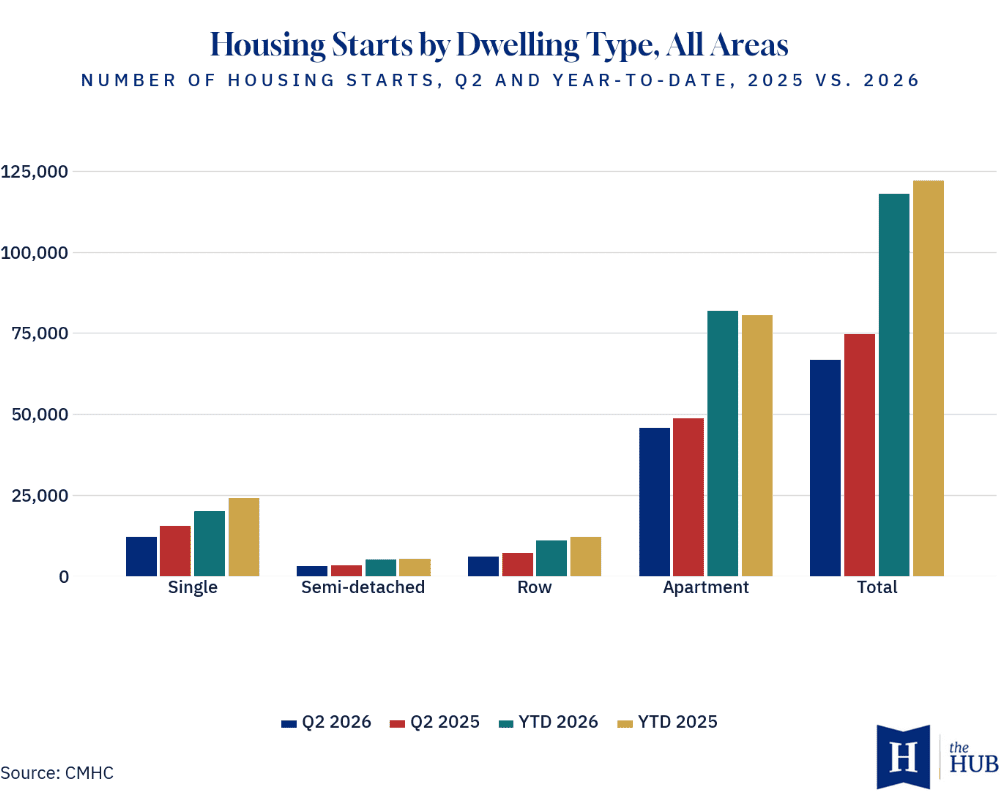
Every apartment unit in a new building counts as an individual housing start. A project containing 300 rental or condominium units therefore contributes 300 starts to the national total.
Recent construction growth has been supported heavily by purpose-built rental apartments and other multi-unit projects. CMHC reported that Canada’s housing starts increased in 2025 largely because of record rental construction and growth in missing-middle housing. At the same time, condominium presales weakened sharply, especially in Toronto and Vancouver, threatening the future supply of ownership-oriented housing.
This creates an important distinction:
Canada may be adding a significant number of rental apartments without producing enough homes that families can eventually purchase.
Rental construction is essential. Growing cities need apartments for students, newcomers, young professionals, seniors and households that are not ready or able to buy.
But rental apartments do not fully replace the need for:
- Family-sized condominiums
- Townhouses
- Semi-detached homes
- Entry-level detached homes
- Larger units suitable for households with children
A high number of apartment starts may therefore improve the overall rental supply while leaving gaps in the ownership market.
Why Are More Apartments Being Built?
Apartments allow a larger number of homes to be constructed on limited urban land.
In high-cost regions such as the GTA, density is often necessary because land, infrastructure and construction expenses make low-density development increasingly difficult.
Governments also encourage development near transit, employment centres and existing services. Purpose-built rentals may benefit from financing programs or incentives designed to make projects more viable.
However, high-density construction is not inexpensive.
Apartment and condominium projects can face:
- High land-acquisition costs
- Development charges
- Lengthy approval periods
- Expensive underground parking
- Labour and material costs
- Financing expenses
- Complex building requirements
- Presale requirements from lenders
A project can be approved by a municipality but still remain unbuilt if expected revenues do not cover development costs.
This helps explain why increasing zoning capacity alone does not always produce immediate housing.
The GTA Condominium Pipeline Faces Pressure
The GTA has historically depended on condominium presales to finance new high-rise construction.
Buyers and investors purchase units before construction, allowing developers to satisfy lender requirements and move projects forward. When presales slow, construction can be delayed, redesigned or cancelled.
CMHC has warned that weak condominium presales and rising unsold inventory are creating vulnerabilities in Toronto’s future housing pipeline. Although rental construction has remained an important source of supply, fewer condominium launches today may result in fewer ownership units being completed several years from now.
This does not necessarily mean condo prices will rise soon. The existing market may still have substantial inventory, especially in certain neighbourhoods or unit categories.
It means the market can experience two different conditions at once:
- More choice for buyers today
- A weaker supply pipeline for the future
Real estate decisions should therefore consider both current listings and longer-term construction trends.
What Does This Mean for GTA Buyers?
For buyers, slower construction does not automatically mean they should rush into the market.
Affordability, mortgage qualification, employment stability and personal plans remain more important than a single housing report.
However, buyers should understand that today’s softer market does not guarantee unlimited future supply.
Those shopping for family-oriented properties may find that new construction increasingly focuses on smaller, higher-density units. Townhouses, semis and reasonably priced detached homes can remain limited in established GTA communities because they require more land and are difficult to produce at lower price points.
Buyers should compare:
- Resale and pre-construction options
- Unit size and layout
- Monthly carrying costs
- Occupancy timeline
- Builder reputation
- Deposit structure
- Community infrastructure
- Long-term suitability
A lower purchase price is not necessarily better if the property no longer meets the household’s needs within a few years.
What Does It Mean for Sellers?
For sellers, a slower construction pipeline can provide long-term support to well-located resale homes, particularly properties that are difficult to reproduce.
These may include:
- Larger condominium units
- Townhouses near transit
- Homes with functional family layouts
- Properties in established school districts
- Homes with parking or outdoor space
- Low-rise properties near major employment areas
However, limited future supply does not mean every property can command an unrealistic price today.
Sellers must still compete with current resale listings, new-project incentives and changing buyer affordability. Pricing should reflect the property’s condition, location, features and the most recent comparable sales.
Long-term supply constraints may support market fundamentals, but they do not remove short-term competition.
What Does It Mean for Investors?
The dominance of apartment construction shows that rental demand remains an important part of Canada’s housing system.
Yet investors should not assume that every condominium or rental property will perform equally.
A market can have strong overall rental demand while certain buildings experience:
- High competition between similar units
- Rising maintenance fees
- Negative monthly cash flow
- Smaller tenant pools
- Lengthy vacancy periods
- Limited resale demand
Investors should evaluate the specific neighbourhood, unit layout, building expenses and target tenant—not simply rely on national housing-shortage headlines.
A one-bedroom unit near a major employment or transit hub may perform very differently from a small investor-oriented unit in an area with many similar completions.
Can Canada Realistically Reach 500,000 Homes a Year?
Reaching close to 500,000 annual homes would require construction activity on a scale Canada has not previously sustained.
TD Economics has noted that the earlier national peak was approximately 260,000 homes in the mid-1970s, illustrating how ambitious the current goal is.
The solution will likely require more than one policy.
Canada may need a combination of:
- Faster and more predictable approvals
- Lower project costs
- More skilled construction workers
- Greater use of modular and prefabricated housing
- Public and private financing
- More serviced land
- Infrastructure investment
- Rental incentives
- Development of missing-middle housing
- Stronger demand for new ownership projects
The key question is not only whether governments announce new housing programs, but whether developers can actually finance, sell and construct projects at prices households can afford.
JDL Realty Perspective
The decline in Canadian housing starts highlights the difference between housing targets and homes that are actually under construction.
Canada clearly needs more supply. But the type of supply matters just as much as the total number.
Rental apartments serve an essential role, especially in growing urban areas. At the same time, the GTA also needs a greater variety of ownership options for first-time buyers, growing families and people who want to remain in their communities as their needs change.
For buyers and sellers, the current market should not be viewed only through short-term price movements.
Interest rates and inventory can shape today’s negotiations, while construction activity influences the market several years from now. Understanding both helps households make more informed real estate decisions.
Final Thoughts
Canada’s June housing-start rate of approximately 239,000 units remains well below the federal ambition of reaching close to 500,000 homes annually. Construction also declined from the previous month, while Ontario faces particular pressure from weak condominium presales and a slowing ownership-housing pipeline.
At the same time, the composition of new supply deserves attention.
A large number of apartment starts can add much-needed rental inventory, but it does not necessarily provide enough family-sized or ownership-oriented housing.
For the GTA, this may mean a market with more rental apartments, fewer future condominium projects and continued scarcity of well-located low-rise homes.
Housing supply is not simply a question of reaching one national number. The homes being built must also be financially viable, appropriately located and suitable for the people expected to live in them.
Source: The Hub

Your Industry Experts
We’re here to help. Whether you’re an agent or a client, we have the support and expertise you need to thrive in your next endeavour.