


September is usually when the GTA housing market starts moving again after the summer.
Buyers return from vacation.
Sellers who waited through July and August put their homes on the market.
And the fall market begins.
But September 2026 did not bring a major rush of buyers back into the market.
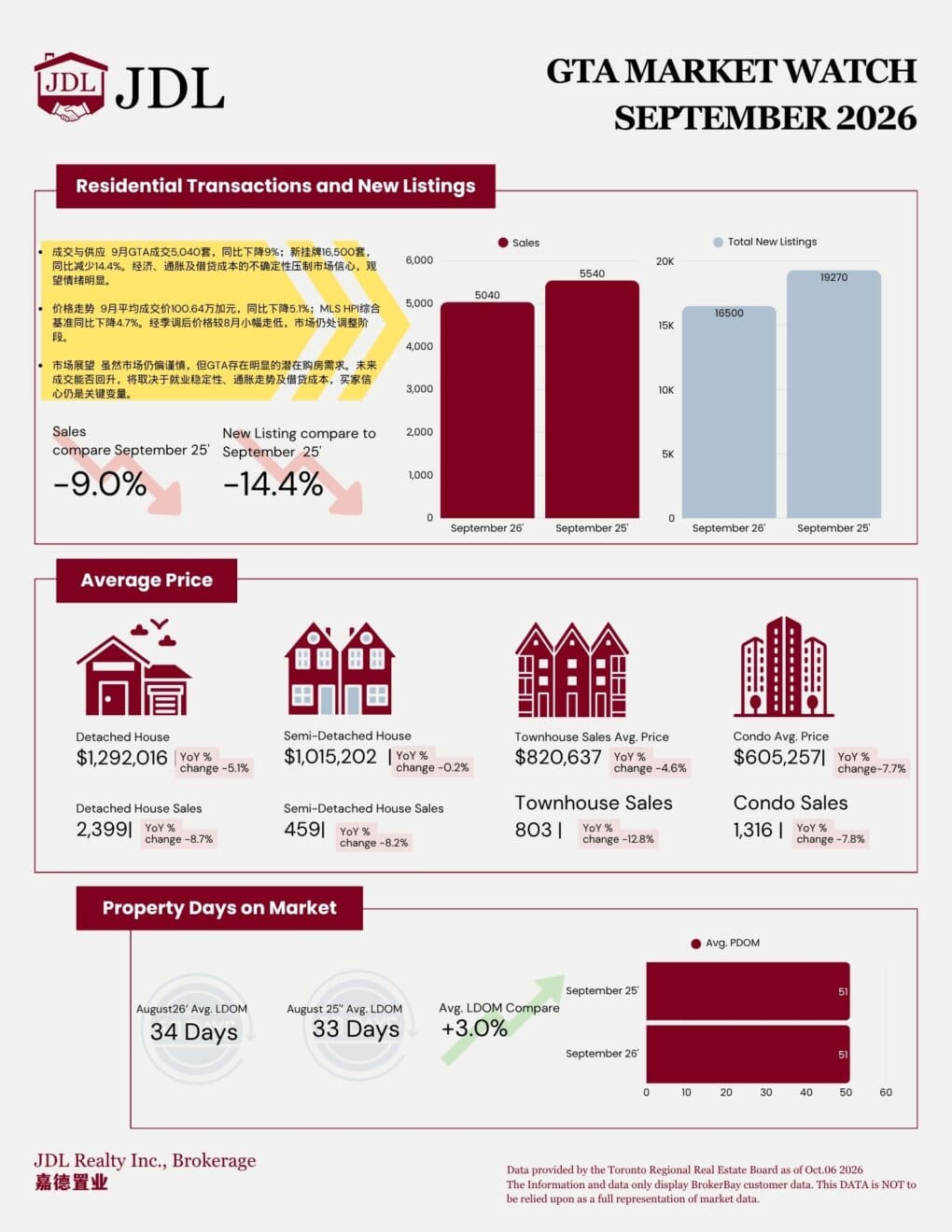
According to the Toronto Regional Real Estate Board, 5,040 homes sold across the GTA in September — down 9% from the same month last year.
At the same time, something else happened:
New listings fell even faster.
Only 16,500 new listings entered the market, down 14.4% year-over-year from 19,270 in September 2025.
The average GTA selling price also declined to:
$1,006,409
down 5.1% year-over-year.
The MLS Home Price Index benchmark was down 4.7%.
At first glance, that sounds simple:
Sales down.
Listings down.
Prices down.
But the September numbers tell a more interesting story.
The GTA market is still soft — but the amount of new competition coming onto the market is also shrinking.
So what does that mean if you are thinking about buying or selling this fall?
September 2026 GTA Market at a Glance
Here are the key numbers:
Home Sales:
5,040
↓ 9.0% year-over-year
New Listings:
16,500
↓ 14.4% year-over-year
Average Selling Price:
$1,006,409
↓ 5.1% year-over-year
MLS Benchmark Price:
↓ 4.7% year-over-year
Average Listing Days on Market:
34 days
vs. 33 days one year ago
Average Property Days on Market:
51 days
unchanged from September 2025
TRREB described buyers as being in a “holding pattern,” with economic uncertainty, inflation and borrowing costs continuing to affect purchasing decisions.
But there is one number buyers and sellers should pay particular attention to:
Listings fell faster than sales.
Sales Are Down—But So Is the Number of Homes Coming to Market
Last September:
5,540 homes sold
and
19,270 new listings came onto the market.
This September:
5,040 homes sold
and
16,500 new listings came onto the market.
That means sales fell by about 500 transactions.
But the number of new listings fell by approximately:
2,770 properties.
So although buyer activity weakened, the flow of new supply weakened even more.
That distinction matters.
If sales were falling while listings continued rising rapidly, sellers would be facing more and more competition.
September showed something different:
fewer buyers, but also fewer new sellers.
That does not automatically mean prices are about to rise again.
But it does mean the GTA market cannot be summarized simply as:
“Nobody is buying and inventory keeps piling up.”
The reality is more complicated.
Buyers Are Still Cautious
There are buyers in the market.
But many are not rushing.
TRREB pointed to uncertainty around:
- Employment
- Inflation
- Borrowing costs
- The broader economy
as reasons some households are continuing to delay their purchase.
That creates a very different buyer mentality than the GTA experienced during highly competitive markets.
A buyer today may look at a property and think:
“I like it—but do I need to buy it this week?”
That matters.
When buyers feel they have alternatives, they are more likely to:
compare properties;
look closely at recent sold prices;
negotiate;
include conditions where appropriate;
and walk away when the numbers do not make sense.
For sellers, that means simply putting a property on MLS and waiting for offers is not necessarily enough.
The Average GTA Home Price Is Back Around $1 Million
The average selling price across the GTA in September was:
$1,006,409
compared with approximately $1.06 million one year earlier.
That represents a 5.1% year-over-year decline.
The benchmark price also declined by 4.7%.
For buyers who were priced out several years ago, lower prices can create opportunities.
But affordability is not determined by purchase price alone.
Buyers still need to consider:
- Mortgage payments
- Interest rates
- Down payment
- Property taxes
- Condo fees
- Insurance
- Closing costs
- Future maintenance
A $50,000 reduction in price does not automatically make a property affordable for every household.
But it can change the calculation — particularly for buyers who already have financing arranged and are waiting for the right property.
Detached Homes: Average Price $1,292,016
Detached homes remained the largest part of GTA sales activity in September.
According to the September market data:
Average detached price:
$1,292,016
Year-over-year price change:
↓ 5.1%
Sales:
2,399
Year-over-year sales change:
↓ 8.7%
For move-up buyers, this creates an interesting situation.
A homeowner may be selling a townhouse or semi-detached property for less than they might have received previously.
But the detached property they want to buy may also be selling at a lower price.
That is why move-up buyers should not only ask:
“How much has my house gone down?”
They should also ask:
“How much has the house I want to buy gone down?”
The gap between the two properties can matter more than either price by itself.
Semi-Detached Homes Held Up Better on Price
Semi-detached homes showed one of the smallest year-over-year average price changes in the September data.
Average price:
$1,015,202
Year-over-year price change:
↓ 0.2%
Sales:
459
Year-over-year sales change:
↓ 8.2%
That does not mean every semi-detached home maintained its value.
Toronto, York Region, Peel and different neighbourhoods can behave very differently.
But it is another reminder that:
“The GTA market is down 5%” does not mean every property is down 5%.
Property type matters.
Neighbourhood matters.
Price range matters.
And condition matters.
Townhouse Prices Fell 4.6%
Townhouses recorded:
Average price:
$820,637
Year-over-year price change:
↓ 4.6%
Sales:
803
Year-over-year sales change:
↓ 12.8%
Townhouses often sit in an important middle ground for GTA buyers.
They may attract:
first-time buyers who need more space than a condo;
families who cannot yet reach detached-home pricing;
and move-up buyers trying to stay within a particular area.
But September also showed townhouse sales falling more sharply than overall GTA transactions.
For sellers in this segment, pricing becomes particularly important.
A buyer may be comparing your townhouse with:
another townhouse;
a semi-detached home;
a larger condo;
or even a smaller detached property.
Your competition is not always the house directly next door.
Condos Saw the Largest Price Decline
Among the major property types in your September report, condo apartments recorded the largest year-over-year average price decline.
Average condo price:
$605,257
Year-over-year price change:
↓ 7.7%
Sales:
1,316
Year-over-year sales change:
↓ 7.8%
For condo buyers, this can create more choices at price points that were previously difficult to reach.
But buyers should still look beyond the purchase price.
A condo that appears inexpensive may carry:
- Higher monthly maintenance fees
- Upcoming increases in fees
- Parking or locker differences
- Building-specific issues
- Different layouts or views
- Different resale demand
For sellers, particularly in condo-heavy areas, buyers may have several similar units to choose from.
That means presentation and pricing can make a major difference.
Homes Are Not Selling Much Faster Than Last Year
The September data also gives us another useful signal.
Average listing days on market were approximately:
34 days
compared with:
33 days one year earlier.
Average property days on market remained:
51 days
in both September 2025 and September 2026.
That is important for sellers.
A home that does not sell in the first week is not necessarily a failed listing.
But it also means sellers need to pay attention to market feedback.
If you have:
very few showings;
many showings but no offers;
repeated comments about price;
or competing listings selling while yours remains available,
the market may be telling you something.
Waiting another month without adjusting strategy does not automatically solve the problem.
What Does September Mean for GTA Buyers?
For buyers, the market still offers something that was difficult to find during the strongest seller markets:
time to compare.
That does not mean every home can be purchased below asking.
Well-located, well-priced properties can still attract strong interest.
But overall softer prices and cautious demand can give buyers more room to evaluate their options.
If you are buying this fall, focus on:
Recent sold prices
Not what a seller hopes to receive.
Competing inventory
What else can your budget buy right now?
Property condition
A lower price is not always better value if the home requires major work.
Financing
Know your comfortable monthly payment before you start negotiating.
Your timeline
If the right home appears, are you actually ready to make an offer?
Buyers waiting indefinitely for “the bottom” face another risk:
If confidence improves and more buyers return, today’s negotiating room may not remain the same.
TRREB says there is still substantial pent-up buyer demand, but many households are waiting for more confidence around employment, inflation and borrowing costs.
What Does September Mean for GTA Sellers?
For sellers, September’s numbers do not mean:
“Nobody is buying.”
More than 5,000 GTA homes still changed hands during the month.
But buyers have become more selective.
That means your pricing strategy matters from the beginning.
A seller should know:
What have comparable homes actually sold for in the last 30–60 days?
What are buyers currently choosing instead of your property?
How many similar listings are available?
How long are they taking to sell?
Have nearby sellers already reduced their prices?
And most importantly:
What happens if the property does not sell at your first asking price?
The biggest mistake in a softer market can be pricing based on:
what your neighbour sold for two years ago;
what you “need” to receive;
or the highest active listing in the neighbourhood.
Buyers are looking at today’s alternatives.
Your pricing needs to do the same.
Is the GTA Becoming a Stronger Market Because Listings Fell 14.4%?
Not necessarily.
This is where the September numbers need to be interpreted carefully.
Yes:
New listings fell faster than sales.
That can reduce some of the supply pressure.
But sales also declined.
Prices also declined.
And buyer confidence remains cautious.
So I would not describe September as:
“The market has turned.”
A better description is:
The market remains soft, but the supply side is starting to tighten as fewer owners choose to list.
That matters because if demand eventually improves while new supply remains limited, the balance could change.
But that depends on what happens next with:
employment;
inflation;
borrowing costs;
consumer confidence;
and local inventory.
JDL Realty Perspective
The most important takeaway from September is not simply:
Sales down 9%.
It is the relationship between all the numbers.
Sales declined.
Prices declined.
But new listings fell even faster.
That creates different opportunities for different people.
A buyer may have more negotiating power than a few years ago.
A seller may face fewer new competing listings than expected.
A move-up buyer may be selling for less — but also buying for less.
A condo buyer may see substantially different conditions from someone shopping for a semi-detached home.
That is why GTA-wide statistics should be the starting point, not the final answer.
What really matters is:
your neighbourhood + property type + price range.
Thinking About Buying or Selling in the GTA This Fall?
Instead of asking:
“Is the market good or bad?”
Start with something more specific.
If you are selling, tell us:
Your neighbourhood + property type
If you are buying, tell us:
Your budget + preferred area + property type
JDL Realty can help you compare recent sold properties, current competing listings and the latest market conditions across Toronto, Markham, Richmond Hill, Vaughan and other GTA communities.
Because the September market may look very different for:
a $600,000 condo;
an $850,000 townhouse;
a $1.1 million semi;
and a $1.6 million detached home.
The GTA is not one market.
The right decision starts with understanding the part of the market you are actually in.
Source: TRREB

Your Industry Experts
We’re here to help. Whether you’re an agent or a client, we have the support and expertise you need to thrive in your next endeavour.