


The GTA housing market remained firmly in buyer-friendly territory in July 2026—but not every neighbourhood followed the same pattern.
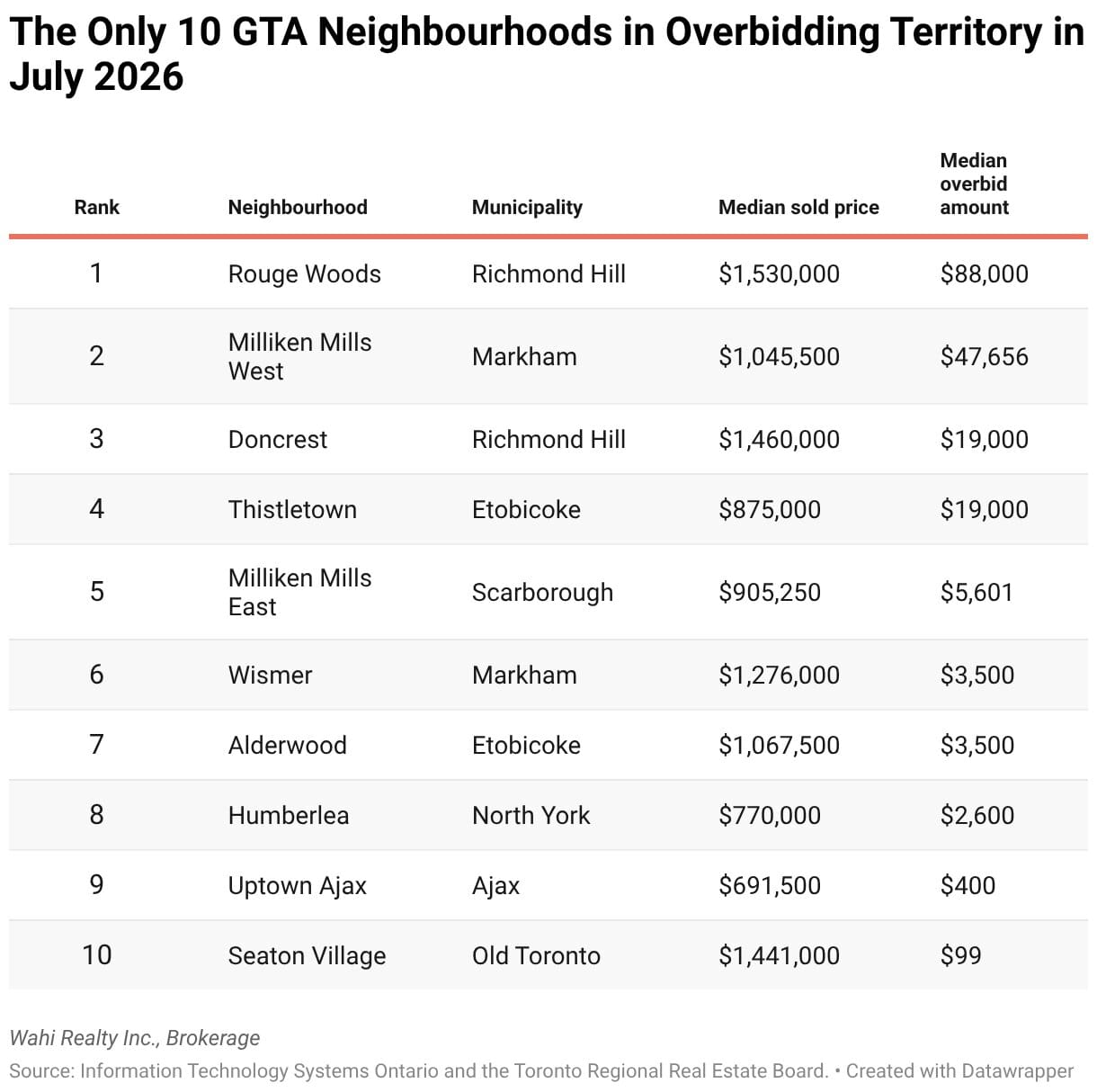
According to a new analysis of resale transactions, only 10 GTA neighbourhoods recorded median sale prices above asking in July. Among the 297 neighbourhoods with at least five transactions, just 3% were in overbidding territory, while 94% were under asking and another 2% were selling at asking.
Even more striking, 78% of the 4,977 individual GTA homes sold in July changed hands below their asking price.
Yet hidden inside this overwhelmingly soft market is a very different story.
Richmond Hill and Markham accounted for three of the five strongest overbidding neighbourhoods in the entire GTA.
That contrast shows why buyers and sellers shouldn’t judge today’s real estate market by GTA-wide averages alone.
Most of the GTA Is Now Selling Below Asking
July was unusually quiet for bidding competition.
Only 10 of the 297 neighbourhoods included in the analysis were classified as overbidding markets. That’s down from 18 neighbourhoods in June.
At the same time, 280 neighbourhoods—or 94%—were in underbidding territory.
The condo market was particularly soft. Among neighbourhoods with at least five condo sales, 98% were underbidding and none were in overbidding territory. Single-family homes performed somewhat better, although 92% of neighbourhoods were still under asking.
On the surface, these numbers point clearly toward a market where buyers generally have more negotiating power.
But zoom in to individual communities, and the picture becomes much more interesting.
The Only 10 GTA Neighbourhoods in Overbidding Territory
The July rankings reveal a striking concentration of competition in a small number of communities.
The first two neighbourhoods stand significantly above the rest.
In Rouge Woods, the median sold price was $1.53 million, with homes recording a median overbid of $88,000.
In Milliken Mills West, the median sold price was approximately $1.046 million, with a median overbid of $47,656.
Doncrest, another Richmond Hill community, ranked third at $19,000 over asking.
Richmond Hill and Markham Are the Big Story
Perhaps the most interesting part of July’s data isn’t simply that 10 neighbourhoods remained competitive.
It’s where they’re located.
During the first half of 2026, much of the GTA’s strongest bidding activity was concentrated in established Toronto neighbourhoods. In July, that shifted outward.
Half of July’s 10 overbidding neighbourhoods were in the 905, and three of the top five were located specifically in Richmond Hill and Markham.
For JDL Realty clients, this is particularly relevant.
Even during a market where most buyers are negotiating below asking, certain York Region communities are still capable of attracting significant competition.
It demonstrates an important principle:
There isn’t one GTA housing market. There are hundreds of local markets behaving differently at the same time.
On the Other Side: Some Homes Sold Nearly $188,000 Below Asking
Now compare the overbidding neighbourhoods with the GTA’s five biggest underbidding markets.
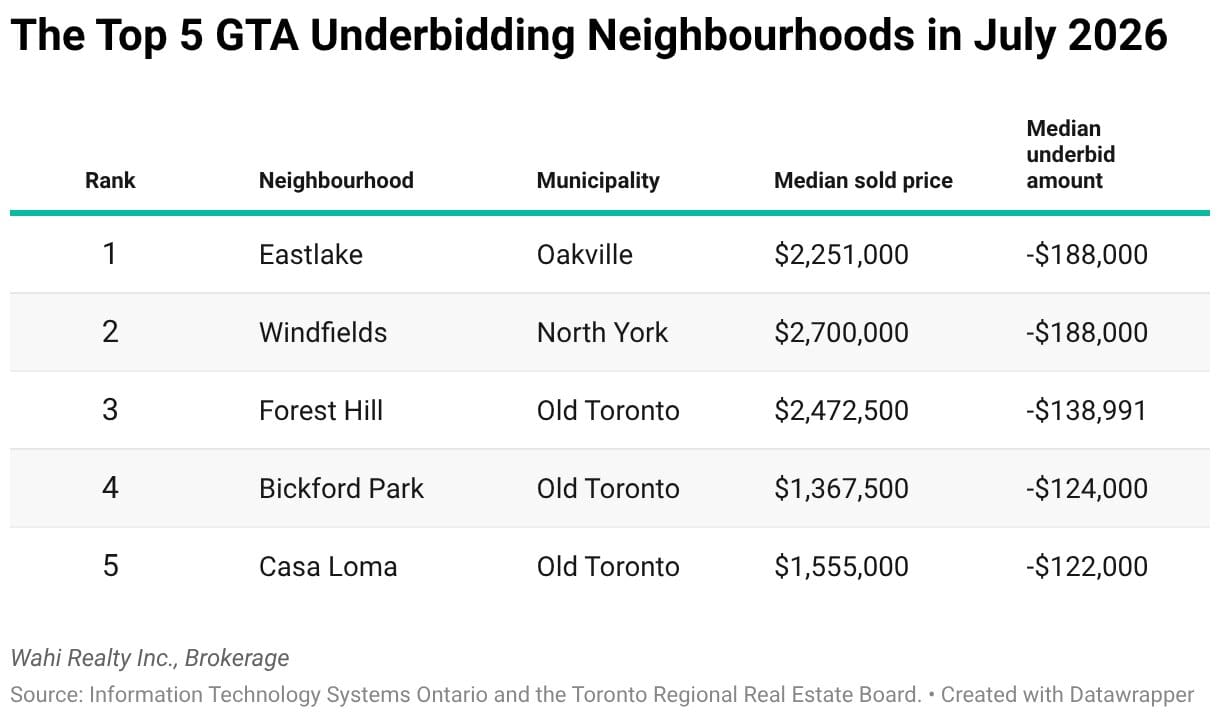
The difference is enormous.
In the same GTA market where Rouge Woods properties had a median overbid of $88,000, Eastlake and Windfields recorded median sale prices $188,000 below asking.
But that doesn’t necessarily mean homes in these neighbourhoods suddenly lost $188,000 in value.
Wahi notes that these rankings measure the difference between asking price and selling price, not changes in underlying property value. Higher-priced and unique luxury properties can also have fewer comparable sales, making accurate initial pricing more difficult.
Selling Over Asking Doesn’t Automatically Mean a Market Is Booming
This distinction is extremely important.
Seeing:
“Sold $88,000 over asking!”
doesn’t automatically mean the buyer overpaid by $88,000.
The asking price itself is part of the seller’s marketing strategy.
Some sellers intentionally list below expected market value to attract attention, encourage multiple offers and create competition.
Wahi specifically cautions that bidding patterns can be influenced by seller pricing strategies and seasonality.
Likewise:
“Sold $188,000 under asking!”
doesn’t necessarily mean the buyer received a $188,000 bargain.
If the original asking price was unrealistic, the eventual selling price may simply represent the property’s actual market value.
That’s why asking price should never be viewed in isolation.
What Does This Mean for GTA Buyers?
The broader July numbers remain favourable for buyers.
With almost eight out of 10 transactions selling below asking, buyers generally have more room to negotiate than during the bidding-war markets of previous years.
But buyers shouldn’t assume that means every property should receive a below-asking offer.
A desirable home in Rouge Woods or Milliken Mills West can behave very differently from a luxury property in another part of the GTA.
Before making an offer, buyers should look at:
recent comparable sales, current competition, days on market, neighbourhood inventory, property condition and the seller’s pricing strategy.
The list price is only the starting point.
What Does This Mean for Sellers?
For sellers, July’s data carries an equally important lesson.
Simply listing a home at a high price and waiting for a buyer may not work in today’s market.
Most GTA neighbourhoods are currently experiencing underbidding.
However, the strong results in a handful of communities demonstrate that buyers will still compete for the right property when pricing, location and demand align.
That makes neighbourhood-level pricing more important than ever.
A seller in Richmond Hill shouldn’t necessarily price a property based on what’s happening across the entire GTA—or even across Richmond Hill as a whole.
The most relevant question is:
What are buyers doing right now for comparable properties in this specific neighbourhood?
Why Local Market Data Matters More Than the GTA Average
July provides an almost perfect example of why GTA-wide statistics can sometimes be misleading.
The overall market says:
78% of homes sold below asking.
But Rouge Woods says:
Median $88,000 over asking.
Milliken Mills West says:
Median $47,656 over asking.
Eastlake says:
Median $188,000 below asking.
All of these can be true at the same time.
The GTA is made up of hundreds of neighbourhoods, each with its own housing stock, buyer demographics, schools, transportation, price ranges, inventory levels and local demand.
Understanding those differences can matter far more than knowing whether the “GTA market” is technically up or down.
Final Thoughts
July 2026 was clearly not a bidding-war market across most of the GTA.
Only 3% of the neighbourhoods analyzed were in overbidding territory, while 94% were underbidding. Nearly eight out of every 10 individual homes sold below asking.
But Richmond Hill and Markham provided a notable exception.
Rouge Woods ranked #1 in the GTA with a median $88,000 overbid, Milliken Mills West ranked #2 at $47,656 over asking, and Doncrest ranked #3 at $19,000 over asking.
For buyers, that means today’s buyer-friendly market doesn’t guarantee every property will be easy to negotiate.
For sellers, it shows that strong demand hasn’t disappeared—it has become far more selective and neighbourhood-specific.
At JDL Realty, we believe today’s market requires more than simply following GTA-wide averages. Understanding what’s happening at the community and property level is increasingly important when deciding how much to offer, how to price a listing, or when to make a move.
Whether you’re buying or selling in Markham, Richmond Hill, Toronto, or elsewhere across the GTA, the right strategy starts with understanding your local market—not just the headline numbers.
Source: Wahi
Your Industry Experts
We’re here to help. Whether you’re an agent or a client, we have the support and expertise you need to thrive in your next endeavour.