



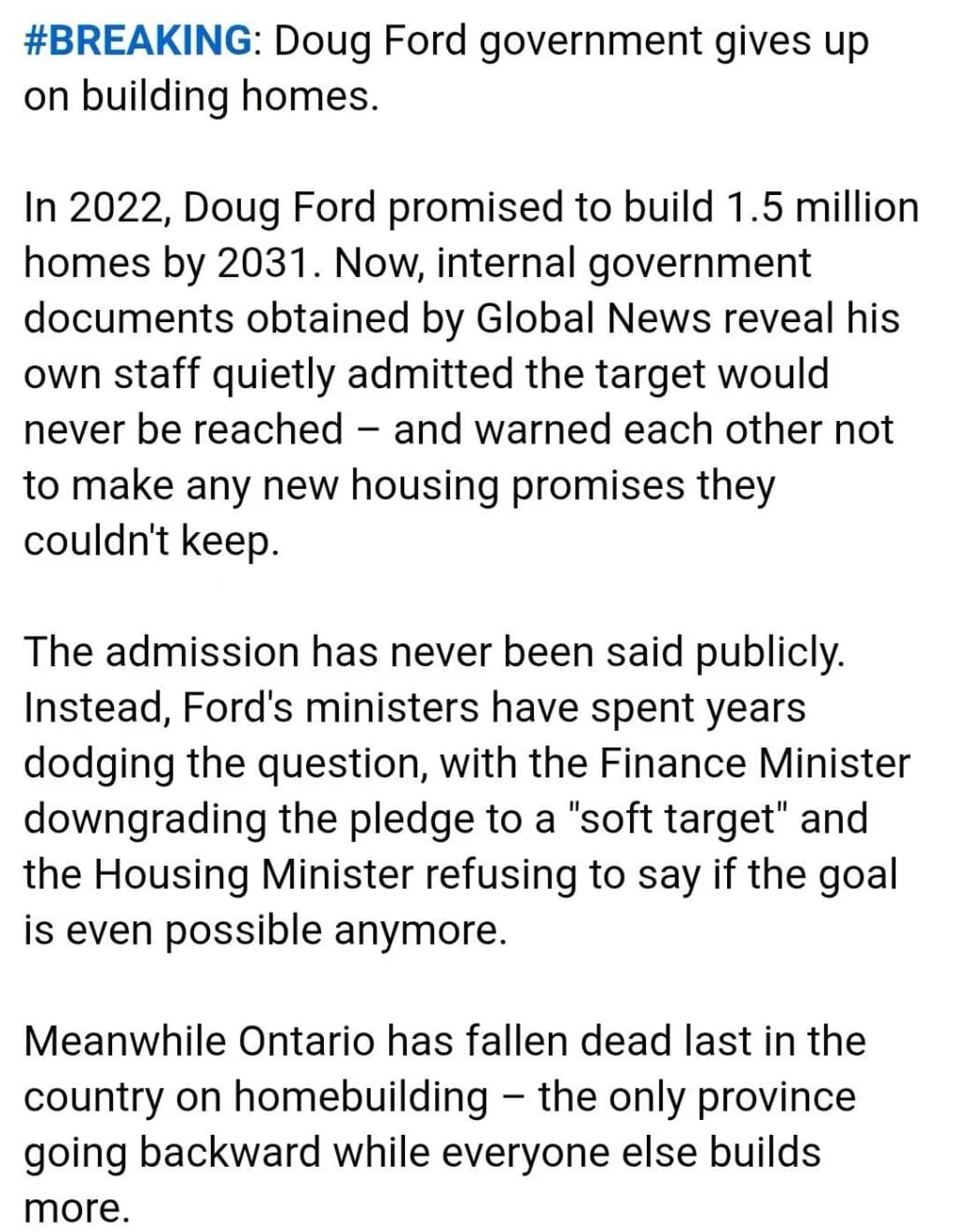
When Premier Doug Ford’s government introduced its ambitious plan to build 1.5 million new homes by 2031, the goal was clear.
Increase housing supply. Improve affordability. Help more Ontarians achieve homeownership.
For many buyers, developers, and industry professionals, the announcement represented one of the province’s biggest housing commitments in decades.
Now, new internal government documents suggest Ontario is unlikely to achieve that target.
According to reporting by Global News, provincial officials acknowledged internally that the province was not on track to reach the 1.5 million-home objective, despite continuing to introduce housing legislation and measures intended to encourage construction.
While the government has emphasized that it remains committed to increasing housing supply, the documents highlight the significant challenges facing Ontario’s housing sector.
The question now becomes:
What does this mean for today’s buyers?
Why Was the 1.5 Million Homes Target Introduced?
Ontario’s population continues to grow rapidly through immigration, international migration, and natural population growth.
Demand for housing has consistently outpaced supply, particularly across the Greater Toronto Area.
Recognizing the growing affordability challenge, the Ford government announced its goal of building 1.5 million homes by 2031.
The strategy was intended to:
- Increase housing supply;
- Improve affordability;
- Reduce competition among buyers;
- Support long-term economic growth;
- Encourage municipalities to accelerate development approvals.
The objective was simple.
Build more homes to help balance supply and demand.
Why Is Ontario Falling Behind?
Building homes requires much more than approving new developments.
Today’s construction environment remains challenging for both developers and builders.
Several factors continue to slow new housing projects:
- Higher borrowing costs;
- Increased construction expenses;
- Labour shortages;
- Slower condominium sales;
- Financing challenges;
- Longer development timelines.
Many developers have delayed launching new projects because current market conditions make construction significantly more expensive than just a few years ago.
Even though long-term housing demand remains strong, today’s economic environment has made it much harder to build at the pace originally envisioned.
Fewer Homes Today Could Mean Less Supply Tomorrow
Some buyers see slower construction as a sign that home prices may continue to soften.
However, housing markets rarely work that way over the long term.
When fewer homes begin construction today, fewer homes will become available several years from now.
As Ontario’s population continues to grow, a reduced future housing supply may once again place upward pressure on prices once demand strengthens.
Real estate has always moved in cycles.
Periods of slower development are often followed by tighter supply when market confidence returns.
What Does This Mean for GTA Buyers?
Ironically, today’s market may offer opportunities that didn’t exist during the competitive years of 2021 and early 2022.
Current buyers benefit from:
- More inventory to choose from;
- Less competition;
- Greater negotiating power;
- Attractive builder incentives;
- Flexible deposit structures on many pre-construction projects.
While future supply remains uncertain, today’s market provides buyers with time to compare properties and make thoughtful decisions without the intense pressure of bidding wars.
The Market Is Becoming More Selective
Today’s buyers are making decisions differently.
Instead of rushing into the market, they are focusing on:
- Monthly affordability;
- Long-term financial stability;
- Community growth;
- Transportation improvements;
- School districts;
- Overall lifestyle.
This shift has created a healthier, more balanced market compared with the rapid price growth seen several years ago.
Should Buyers Wait?
Many people assume that if housing construction slows, prices will automatically fall further.
Unfortunately, real estate rarely follows such a simple pattern.
If fewer homes are built over the next several years while Ontario’s population continues to grow, today’s supply challenges may become tomorrow’s inventory shortages.
Rather than trying to perfectly time the market, buyers should focus on:
- Their financial readiness;
- Mortgage affordability;
- Long-term housing goals;
- Purchasing a property that fits both today’s needs and tomorrow’s plans.
History has shown that opportunities often appear before market confidence fully returns.
Every Market Cycle Creates New Opportunities
Real estate markets never move in one direction forever.
Today’s headlines focus on missed housing targets.
Tomorrow’s headlines may focus on limited inventory.
Neither tells the complete story.
Successful buyers understand that every market cycle creates different opportunities.
The key is recognizing them before everyone else does.
JDL Realty | Helping Buyers Navigate a Changing Market
At JDL Realty, we believe buying real estate should never be based solely on headlines.
Every buyer’s situation is different.
Whether you’re:
- Purchasing your first home;
- Upgrading to a larger property;
- Buying a pre-construction home;
- Investing for the long term;
- Relocating to the GTA;
our team helps you understand market trends while building a strategy that fits your financial goals and lifestyle.
Because successful real estate decisions aren’t about predicting tomorrow’s headlines.
They’re about understanding today’s opportunities.
Final Thoughts
Ontario’s housing challenge did not begin overnight, and it won’t be solved overnight.
The Ford government’s ambitious goal of building 1.5 million homes reflected the province’s recognition of a serious housing shortage, but recent reports suggest that reaching that target will be more difficult than originally expected.
For buyers, this is a reminder that housing supply remains one of the biggest long-term drivers of the Ontario real estate market.
Rather than focusing only on today’s news, successful buyers look at the bigger picture.
Understanding market cycles, planning, and making informed decisions will always matter more than trying to perfectly predict the next headline.
Source: Global News

Your Industry Experts
We’re here to help. Whether you’re an agent or a client, we have the support and expertise you need to thrive in your next endeavour.