


A Market That Looks Confusing — But Isn’t
At first glance, today’s housing market in Ontario can feel contradictory.
On one hand, buyers are seeing more inventory, more choice, and less urgency.
On the other hand, long-term concerns about housing shortages continue to dominate discussions.
These two realities are not conflicting. They are part of the same cycle.
The First Signal: Single-Family Supply Is Drying Up
Recent data from CMHC highlights a significant trend in single-family home completions across Ontario.
In February 2026, completions dropped to just 897 units — the lowest level recorded since at least 1990.
This is not a minor fluctuation. It reflects a structural slowdown in low-density housing supply.
What this means
- Fewer detached and freehold homes are being delivered
- Future inventory in this segment is shrinking
- Long-term supply pressure is quietly building
In practical terms, the pipeline for low-density housing is already being constrained.
The Second Signal: Condo Supply Surge — For Now
At the same time, the GTA condo market is experiencing the opposite dynamic in the short term.
Projects launched during peak years are now reaching completion, leading to:
- Over 20,000 units are expected to be completed in 2026
- Approximately 17,000 units expected in 2027
- Additional unsold inventory entering the market
What this creates
A temporary wave of supply.
This explains why in the current market:
- Prices are under pressure in certain segments
- Rental markets are softening
- Investors are facing tighter conditions
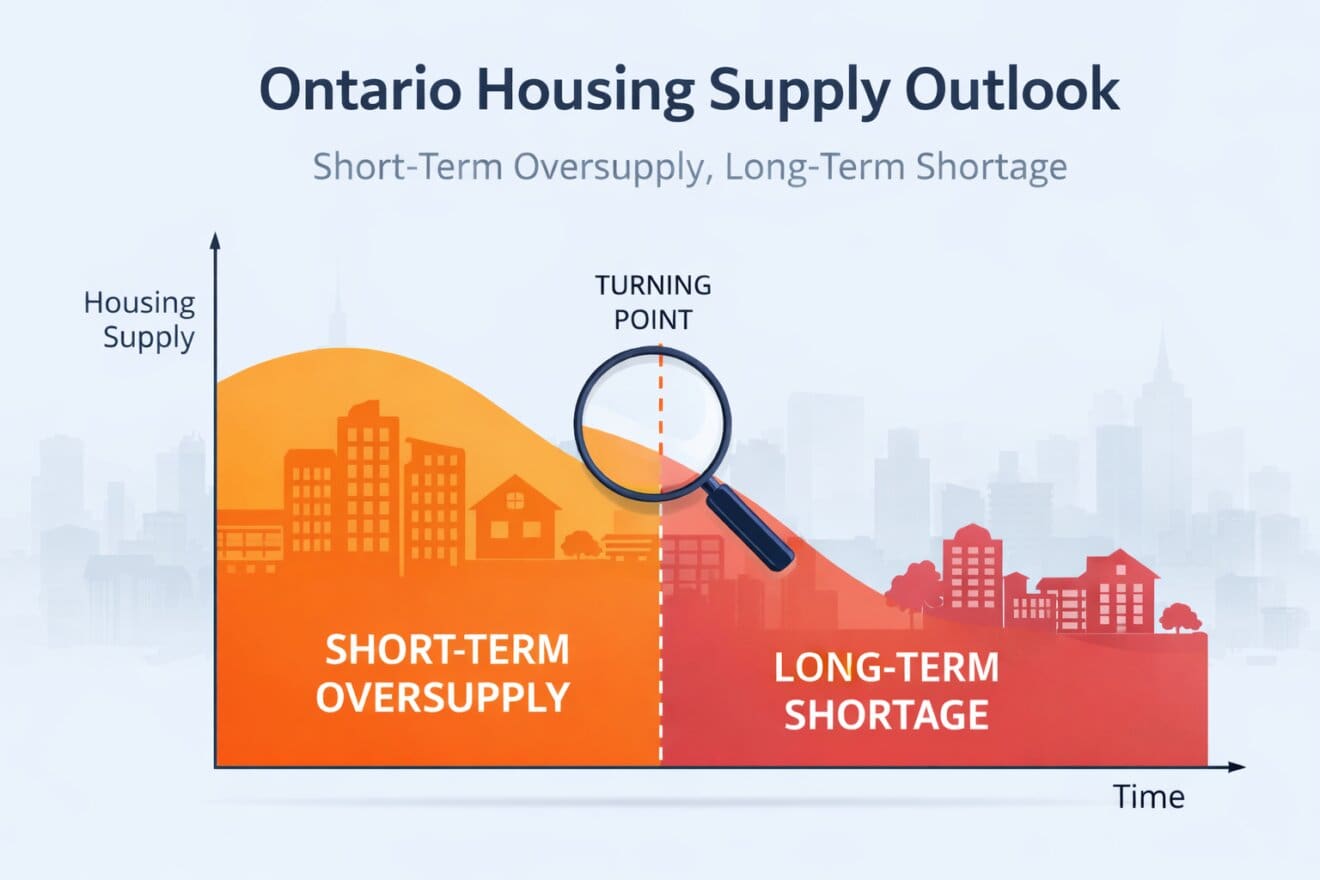
The Turning Point: A Sharp Drop After 2027
What makes this cycle particularly important is what follows.
After 2027, the supply pipeline declines sharply:
- Around 8,600 units projected in 2028
- Only a few hundred units are projected by 2029
Why is this happening?
Over the past two years:
- New project launches have slowed significantly
- Developers have delayed or cancelled projects
- Financing and market conditions have reduced the new supply
The result is that future supply is being constrained in advance.
Understanding the Full Cycle
When these trends are considered together, a clear pattern emerges:
Short Term (2026–2027)
- Supply peak
- Market pressure
- Inventory absorption
Medium Term (2027–2028)
- Supply contraction
- Market stabilization
- Gradual improvement in conditions
Long Term (Post-2028)
- Supply shortage risk
- Potential for renewed upward pressure
What This Means for Buyers
For buyers, today’s market presents a unique window.
There is more supply available in the short term, while long-term supply is tightening.
This creates conditions where
- Buyers have more choices
- Competition is more manageable
- Decisions can be made more strategically
What This Means for Investors
For investors, the current environment requires a broader perspective.
Short-term conditions may feel more challenging due to increased supply and slower rent growth.
However, the declining future pipeline suggests tightening conditions over time.
A Market Defined by Timing and Structure
The key takeaway is not simply whether the market is rising or falling.
It is about understanding where the market sits within a larger cycle.
Ontario is currently transitioning from short-term supply pressure toward long-term structural constraint.
Final Thoughts
The data present a clear conclusion:
Short-term oversupply is temporary.
Long-term supply pressure is already forming.
For buyers and investors, recognizing this shift early can make a meaningful difference in decision-making.
Source: CMHC

Your Industry Experts
We’re here to help. Whether you’re an agent or a client, we have the support and expertise you need to thrive in your next endeavour.