


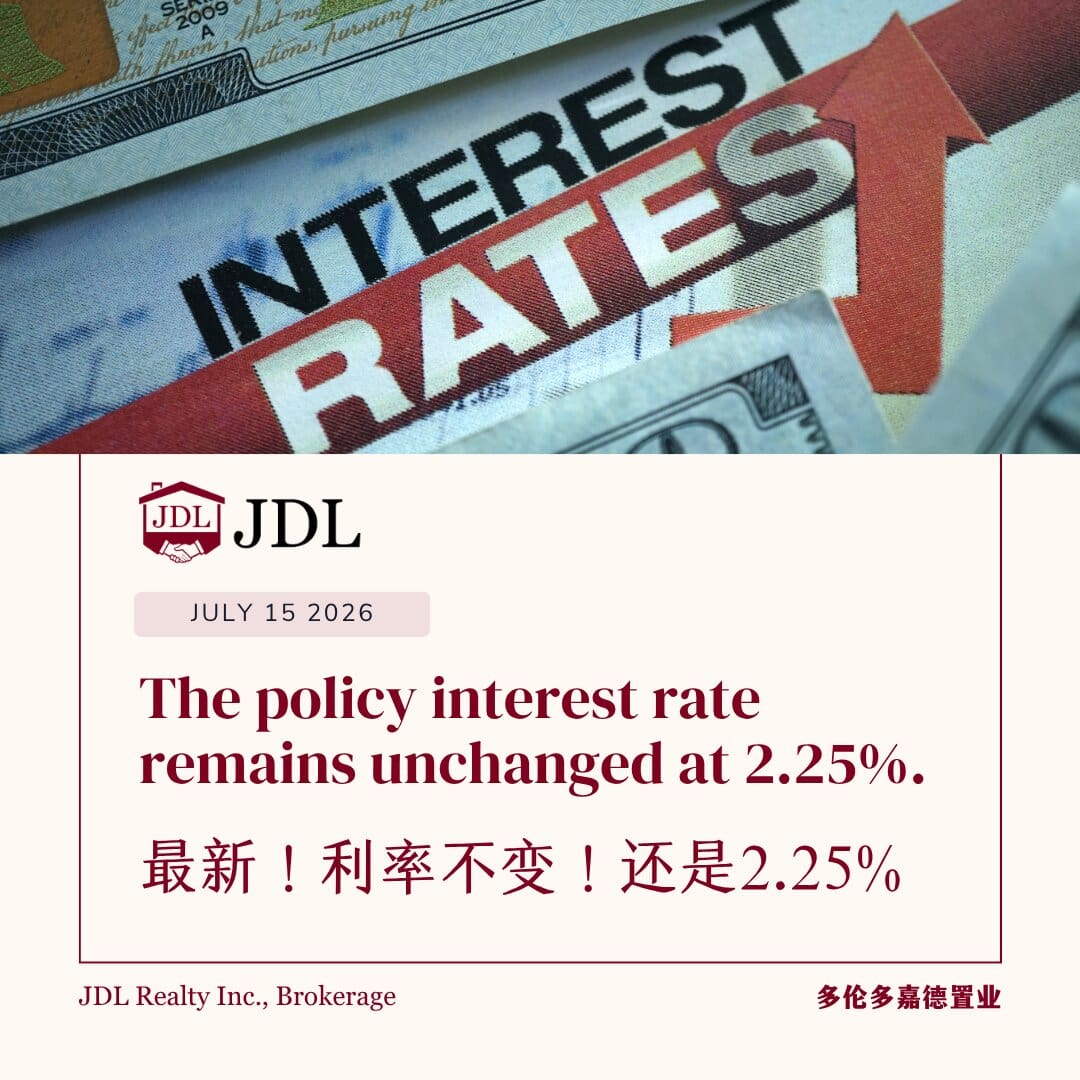
On July 15, 2026, the Bank of Canada maintained its target for the overnight rate at 2.25%, marking the sixth consecutive rate announcement without a change. The Bank Rate remains at 2.50%, while the deposit rate remains at 2.20%.
The decision was widely expected, but it remains important for Canadian homeowners and prospective buyers.
An unchanged rate does not immediately make housing more affordable, nor does it guarantee that mortgage rates will remain exactly where they are. However, it provides something many buyers, sellers and homeowners value: greater short-term stability.
Alongside the rate decision, the Bank released its July Monetary Policy Report. It described Canada’s economy as weak but showing signs of improvement, with growth expected to strengthen and inflation projected to ease toward approximately 2%. The Bank also emphasized that economic uncertainty remains elevated.
For the Greater Toronto Area real estate market, the latest decision may help households plan with more confidence—but interest rates remain only one part of the buying or selling decision.
What Did the Bank of Canada Announce?
The Bank of Canada kept its benchmark overnight rate at 2.25% on July 15.
This is the rate the central bank uses to influence borrowing costs and economic activity across Canada. It affects financial institutions’ short-term funding costs and is closely connected to lenders’ prime rates.
The policy rate has remained at 2.25% since October 2025, after a series of earlier rate reductions. July’s announcement represents the sixth consecutive hold.
The decision means there was:
- No new rate cut;
- No rate increase;
- And no immediate policy-driven change to lenders’ prime rates.
However, individual banks and mortgage lenders can still adjust their products and discounts based on funding costs, competition and bond-market movements.
Why Did the Bank Keep the Rate Unchanged?
The Bank of Canada is currently balancing weak economic growth against continued inflation risks.
Canada’s economy has been soft, although recent information suggests activity may improve during the second half of 2026. At the same time, higher energy costs and global uncertainty continue to affect consumer prices and business expenses.
In its July outlook, the Bank lowered its forecast for Canadian economic growth in 2026 to approximately 0.7%, down from the 1.2% forecast published previously. However, it expects growth to strengthen later in the year and made modest upward revisions to its outlook for 2027 and 2028.
The Bank also raised its 2026 inflation forecast to approximately 2.5%, from 2.3%, while continuing to expect inflation to move closer to the 2% midpoint of its target range over time.
Holding the rate gives the Bank more time to assess whether:
- Economic growth continues to recover;
- Inflation pressures ease as expected;
- Higher energy prices spread into other goods and services;
- And global trade and geopolitical uncertainty continue to affect Canada.
The decision suggests the Bank did not see an immediate need either to provide more stimulus through a rate cut or to slow inflation through a rate increase.
Does a 2.25% Policy Rate Mean You Can Get a 2.25% Mortgage?
No.
The Bank of Canada’s policy rate is not the mortgage rate offered directly to home buyers.
The mortgage rate available to an individual borrower depends on factors such as:
- Fixed or variable mortgage structure;
- Mortgage term;
- Down payment;
- Credit history;
- Income and debt levels;
- Whether the mortgage is insured;
- Property type;
- Lender pricing;
- And market conditions.
Variable mortgage rates are generally linked to a lender’s prime rate. Fixed mortgage rates are influenced more heavily by Government of Canada bond yields and expectations regarding future inflation and interest rates.
As a result, fixed mortgage rates can change even when the Bank of Canada leaves its policy rate unchanged.
Buyers should compare actual mortgage products rather than assuming the policy rate represents the rate they will receive.
What Does the Rate Hold Mean for Variable-Rate Borrowers?
For most variable-rate mortgage holders, the July announcement should not produce an immediate policy-driven change in their borrowing rate.
Depending on the mortgage structure, this may mean:
- Monthly payments remain unchanged;
- The amount applied toward principal and interest remains similar;
- Or the borrower’s amortization schedule remains generally stable.
Homeowners with home-equity lines of credit may also see no immediate change because these products are usually tied to the lender’s prime rate.
However, borrowers should still review their individual mortgage terms. Not every variable mortgage works in the same way, and lenders can apply different discounts or premiums to prime.
What Does It Mean for Fixed Mortgage Rates?
The effect on fixed mortgage rates is less direct.
Fixed rates are influenced mainly by bond yields, lender funding costs and market expectations about future economic conditions.
Therefore, fixed mortgage rates could:
- Remain stable;
- Move lower;
- Or increase even while the Bank of Canada continues holding its policy rate.
A rate hold can reduce some uncertainty, but it does not freeze the mortgage market.
Buyers and homeowners approaching renewal should compare current offers, not rely only on the Bank of Canada headline.
What Does the Decision Mean for GTA Home Buyers?
1. More Predictability When Planning a Purchase
For buyers, the greatest immediate benefit may be stability.
There is no new Bank of Canada increase suddenly reducing affordability, and buyers have a more predictable short-term environment in which to:
- Update a mortgage pre-approval;
- Estimate monthly payments;
- Calculate closing costs;
- Compare fixed and variable options;
- And set a responsible purchase budget.
Pre-approvals may have expiry dates and are not final mortgage commitments, so buyers should confirm their borrowing capacity before submitting an offer.
2. Waiting Does Not Guarantee a Lower Mortgage Rate
Some buyers remain on the sidelines because they expect another rate cut.
Rates may eventually decline, but the July decision shows that the Bank is currently comfortable holding at 2.25% while it evaluates economic growth and inflation.
Waiting for a lower rate can also create a trade-off.
If borrowing costs decline later:
- More buyers may enter the market;
- Competition may increase;
- Sellers may become less flexible;
- And desirable properties may receive more offers.
A lower mortgage rate does not always result in a less expensive purchase if home prices or competition rise at the same time.
The decision to buy should be based on personal financial readiness, not only a prediction about the Bank’s next announcement.
3. Buyers May Still Have Negotiating Power
An unchanged interest rate does not automatically create a seller’s market.
In areas with higher inventory or slower sales, buyers may still be able to negotiate:
- Purchase price;
- Closing date;
- Financing conditions;
- Home-inspection conditions;
- Repairs;
- Appliances and other inclusions;
- Or other terms of the agreement.
Market conditions can differ significantly by neighbourhood, price range and property type.
A downtown Toronto condo may face very different demand from a detached house in Markham, Richmond Hill or Vaughan. Buyers should evaluate the specific local market rather than rely only on GTA-wide headlines.
4. Affordability Should Be Based on the Full Cost of Ownership
A stable interest rate does not remove the other costs associated with buying a home.
Buyers should budget for:
- Down payment;
- Mortgage payment;
- Land transfer tax;
- Legal fees;
- Property insurance;
- Home inspection;
- Property taxes;
- Condo fees, where applicable;
- Utilities;
- Repairs and maintenance;
- Moving costs;
- And emergency savings.
In Toronto, buyers may be responsible for both the provincial and municipal land transfer taxes.
The maximum mortgage amount offered by a lender should not automatically become the buyer’s target purchase price. A comfortable budget should leave room for future expenses and unexpected changes.
What Does the Decision Mean for GTA Home Sellers?
1. Stable Rates May Gradually Support Buyer Confidence
When interest rates stop changing frequently, some buyers feel more comfortable returning to the market.
The July hold may support confidence among buyers who were uncertain about another immediate increase.
However, stability does not mean every listing will sell quickly.
Many buyers remain cautious and compare price, condition, location and monthly carrying costs carefully before submitting an offer.
2. Correct Pricing Remains Essential
The Bank of Canada announcement cannot compensate for an unrealistic listing price.
Properties priced too far above recent comparable sales may remain on the market, especially where buyers have many alternatives.
Sellers should review:
- Recent sold properties;
- Current competing listings;
- Days on market;
- Price reductions;
- Neighbourhood inventory;
- Property condition;
- And current buyer demand.
A successful pricing strategy should reflect today’s market rather than the price a seller hopes to receive after a future rate cut.
3. Presentation and Marketing Still Matter
In a selective market, buyers often make decisions quickly based on how a property is presented.
Sellers may benefit from:
- Decluttering;
- Minor repairs;
- Professional cleaning;
- Strategic staging;
- High-quality photography;
- Accurate floor plans;
- Strong online presentation;
- And coordinated showing availability.
Interest-rate stability may bring more buyers into the market, but strong preparation helps a listing stand out from competing properties.
4. Waiting for Lower Rates Does Not Guarantee a Higher Sale Price
Some owners may consider delaying their sale until rates fall.
That strategy may work in certain circumstances, but lower rates do not automatically guarantee higher prices.
Future selling conditions will also depend on:
- The number of new listings;
- Employment and income growth;
- Consumer confidence;
- Mortgage qualification rules;
- Condo and new-construction inventory;
- Population growth;
- And local demand.
A seller should consider their personal timeline, next purchase and financial goals—not only interest-rate forecasts.
What Does It Mean for First-Time Home Buyers?
First-time buyers may benefit from a more stable rate environment, but they still need to prepare carefully.
Before beginning a home search, buyers should:
- Review their credit;
- Save for a down payment and closing costs;
- Obtain a mortgage pre-approval;
- Understand the mortgage stress test;
- Build an emergency reserve;
- Compare neighbourhoods and property types;
- And identify a monthly payment that is genuinely comfortable.
They should also understand that a pre-approval does not guarantee final financing. The lender may still need to review the property, appraisal and updated borrower information before approving the mortgage.
For this reason, buyers should be cautious about removing a financing condition solely to make an offer appear more competitive.
What Does the Decision Mean for Homeowners Renewing Their Mortgages?
A policy-rate hold provides some stability, but many homeowners renewing in 2026 may still face higher payments than they had during their previous mortgage term.
Bank of Canada research previously estimated that many mortgage holders renewing in 2025 and 2026 could experience payment increases, particularly borrowers coming out of older five-year fixed mortgages.
Homeowners approaching renewal should begin reviewing options early.
Important considerations include:
- The existing lender’s renewal offer;
- Offers from other lenders;
- Fixed versus variable rates;
- Mortgage penalties;
- Remaining amortization;
- Prepayment privileges;
- Portability;
- And the total borrowing cost.
Homeowners planning to sell near their renewal date should understand the potential penalty for breaking or discharging the mortgage.
The lowest advertised rate is not always the best product if it comes with restrictive terms or higher penalties.
What Does It Mean for Real Estate Investors?
A stable rate environment can make it easier for investors to estimate financing costs, but it does not make every property a good investment.
Investors should calculate:
- Mortgage payment;
- Expected rental income;
- Property taxes;
- Condo fees;
- Insurance;
- Utilities paid by the owner;
- Repairs and maintenance;
- Vacancy allowance;
- Property-management costs;
- Closing expenses;
- And potential future capital expenditures.
A property that depends entirely on rapid appreciation may carry greater risk than one supported by realistic rental demand and manageable expenses.
Investors should also consider whether the property’s cash flow can tolerate changes in mortgage rates, vacancy or repair costs.
Fixed or Variable Mortgage: Which Is Better After the Rate Hold?
There is no universal answer.
A fixed mortgage may be more suitable for borrowers who:
- Prefer predictable payments;
- Have limited room in their monthly budget;
- Want protection from future rate increases;
- Or value certainty over potential savings.
A variable mortgage may appeal to borrowers who:
- Can tolerate rate fluctuations;
- Expect rates to decline over their term;
- Have financial flexibility;
- Or value certain conversion and prepayment features.
The decision should reflect the borrower’s risk tolerance, income stability, future plans and mortgage terms.
A buyer planning to move within a few years may have different priorities from someone planning to keep the home for a decade.
Should You Buy Now or Continue Waiting?
The most useful question is not necessarily whether rates will rise or fall next.
It is:
Are you financially and personally ready to buy?
Buying may make sense when:
- Your income is stable;
- You have sufficient savings;
- The full monthly cost fits your budget;
- You plan to own the property for a reasonable period;
- And the home supports your long-term goals.
Waiting may be more appropriate when:
- Employment is uncertain;
- Savings are limited;
- The purchase would leave no emergency reserve;
- A major life change is approaching;
- Or you have not yet researched the market.
Trying to purchase at the exact bottom of both interest rates and home prices is extremely difficult.
A sound purchase should remain manageable even if property values or borrowing costs do not immediately move in the buyer’s favour.
JDL Realty’s Perspective
The July 15 decision does not instantly change the GTA real estate market.
What it does provide is a greater degree of predictability.
For buyers, this may be a good time to update a mortgage pre-approval, review affordability and explore neighbourhoods where current inventory provides negotiating opportunities.
For sellers, stable rates may gradually support buyer confidence, but pricing and presentation remain critical.
For investors, the focus should remain on property fundamentals, realistic rental income and long-term demand rather than short-term interest-rate predictions.
The GTA is not one uniform market. Conditions vary across Toronto, Markham, Richmond Hill, Vaughan, Mississauga, Oakville and surrounding communities. They also differ among condos, townhouses and detached homes.
The right strategy should be based on current local data and the client’s own goals—not only a national interest-rate headline.
Final Thoughts
The Bank of Canada’s July 15, 2026 decision to maintain its policy rate at 2.25% means Canadian borrowers are not facing an immediate central-bank-driven rate increase or decrease.
The Bank expects economic growth to improve after a weak start to the year and inflation to move back toward approximately 2%, although uncertainty remains high.
For GTA real estate:
- Buyers gain greater short-term financing stability;
- Sellers may see buyer confidence improve gradually;
- Homeowners should still prepare carefully for mortgage renewals;
- And investors should continue evaluating the complete financial picture.
At JDL Realty, we help GTA buyers, sellers and investors understand how current market conditions affect their real estate plans. Whether you are purchasing your first home, preparing to sell, considering an investment or planning your next move, a successful decision begins with accurate local information and a strategy built around your goals.
Disclaimer: This article is provided for general informational purposes only and does not constitute financial, mortgage, investment, legal or tax advice. Mortgage rates and lending products can change, and individual qualification depends on the borrower, property and lender. Readers should consult qualified mortgage, financial, legal and tax professionals regarding their specific circumstances.
Source: Bank of Canada

Your Industry Experts
We’re here to help. Whether you’re an agent or a client, we have the support and expertise you need to thrive in your next endeavour.